2026-10-23
CNNC Insurance Company Limited: a case study in captive establishment
Core question: why and how did China National Nuclear Corporation establish a dedicated captive, CNNC Insurance, in Hong Kong, and what does the case mean for the Hong Kong captive market and for nuclear risk management?
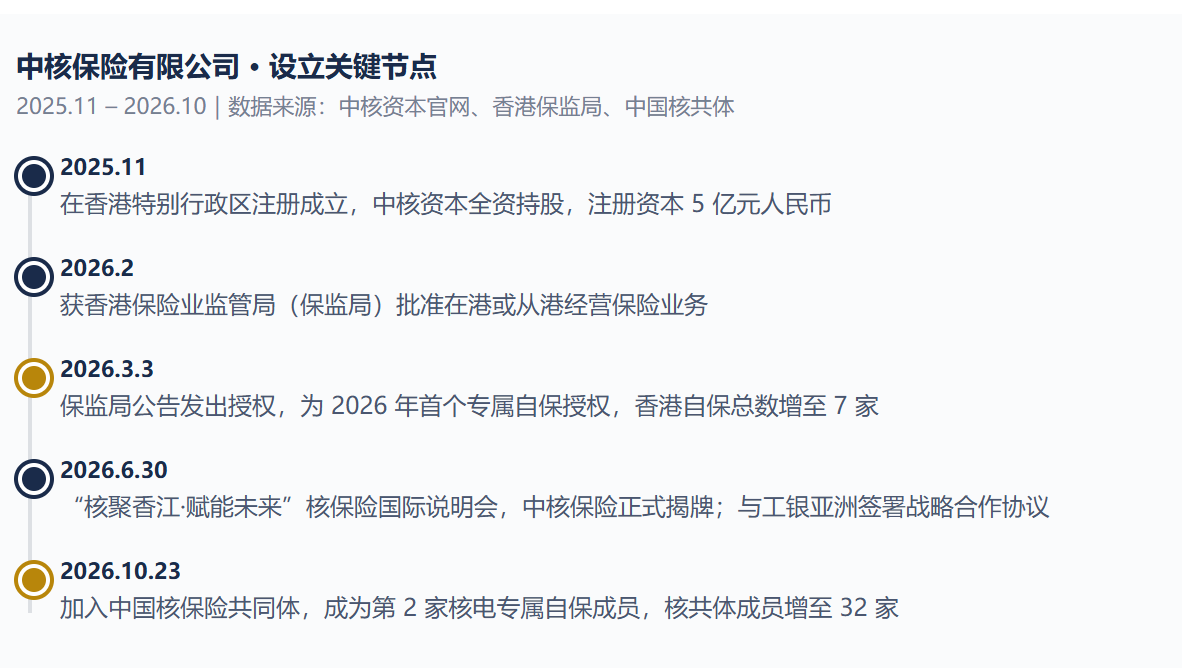
- Entity and path: CNNC Insurance was incorporated in Hong Kong in November 2025, wholly owned by CNNC Capital with registered capital of RMB 500 million. It was authorised by the Insurance Authority in February 2026, the first licence of the year, and unveiled on 30 June, making it the first of three Hong Kong captives licensed within seven months in 2026.
- Drivers: responding to the challenges of globalised operations in the opening year of the 15th Five-Year Plan, extending the group risk control system overseas and building an international risk management centre and financial bridgehead.
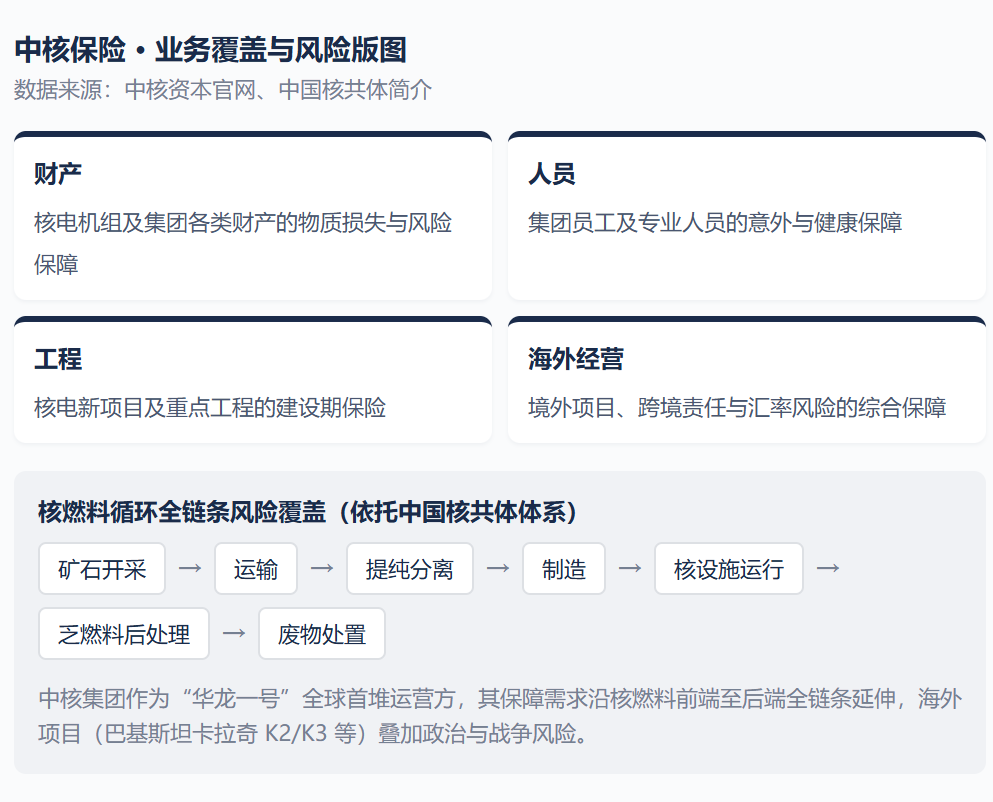
- Business logic: covering the group's four pillars of property, people, engineering and overseas operations, and drawing on Hong Kong's rule of law and green finance environment to develop nuclear-themed green insurance and carbon finance products.
- Ecosystem position: it joined the China Nuclear Insurance Pool on 23 October 2026 as the second nuclear dedicated captive member, forming a nuclear duo with CGN and lifting pool membership to 32.
One: case overview, three strategic intentions behind a single captive licence
CNNC Insurance Company Limited is the first captive approved in Hong Kong in 2026 and the first dedicated insurance platform established overseas by CNNC Group. It is not merely a tool to save premium for the group, but a key move by CNNC Group in the opening year of the 15th Five-Year Plan to extend its risk management capability internationally. Wang Xuejun, member of the group's party leadership group and chief accountant, set out three roles at the unveiling: an overseas extension platform for the group risk control system, a talent hub for international nuclear financial professionals, and a risk management centre and financial bridgehead for international expansion. From the perspective of the Hong Kong market, the significance of CNNC Insurance is that it adds a new example in the most mature client segment of state-owned energy: together with CGN Insurance, established in 2014, it forms a nuclear duo, but with different business emphasis. CGN focuses on operating-phase risk at units in service, while CNNC Insurance carries more of the risk from uranium mining and milling, nuclear fuel reprocessing and overseas Hualong One projects.
Two: establishing entity and key timeline
CNNC Insurance followed a clear path of incorporation, authorisation, unveiling and pool membership over about 11 months. The parent, China National Nuclear Corporation Capital Holding Company Limited (CNNC Capital), a group financial holding platform, wholly owns the RMB 500 million registered capital, a scale well above the HK$2 million minimum paid-up capital for Hong Kong captives, reflecting an intention to carry risk with real capital rather than a purely structural arrangement. Two milestones stand out. First, the Insurance Authority announced the authorisation on 3 March 2026, the first licence of the year; Clement Cheung said captives "have become an important component of enterprise risk management for global commercial organisations" and described the establishment of CNNC Insurance as encouraging. Second, on 23 October 2026, the date of this report, CNNC Insurance formally joined the China Nuclear Insurance Pool at its annual meeting, lifting membership from 31 to 32.
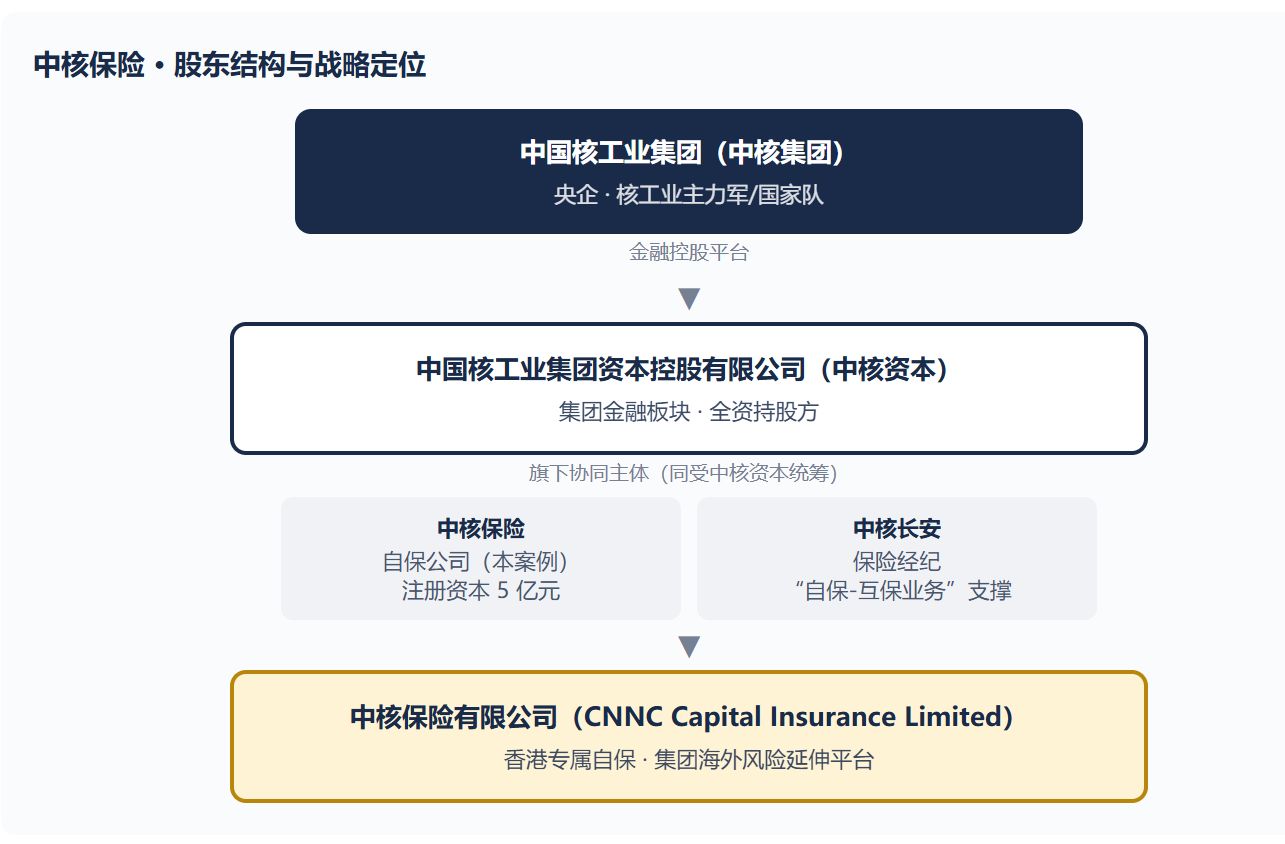
Three: shareholding structure and strategic positioning
CNNC Insurance sits at the end of a three-tier structure of group, financial platform and specialist company: CNNC Group, a central state-owned enterprise, controls CNNC Insurance wholly through CNNC Capital, working in coordination with another group financial entity, CNNC Chang'an, an insurance broker. CNNC Chang'an has long built a model centred on broking with individual internet insurance and captive and mutual business as supporting pillars, and once CNNC Insurance was in place the group's captive and mutual risk management loop could be given physical form in Hong Kong. This model, in which the parent sets up the captive and the in-house broker arranges cover, is the standard structure for risk retention in large groups: the broker designs programmes and arranges reinsurance, the captive retains risk and underwrites offshore, and the two are connected through group capital.
Four: drivers, why Hong Kong and why now
The establishment of CNNC Insurance results from a combination of internal and external factors at three levels:
| Level | Driver | Response |
|---|---|---|
| Strategic timing | Opening year of the 15th Five-Year Plan, with rising challenges in globalised operations | Anchored to the three-step nuclear development strategy, strengthening specialised risk controls |
| Assets going overseas | Growing exposure on overseas Hualong One projects (K2 and K3 in Pakistan) and overseas uranium mines (Rossing in Namibia) | Political, war and currency risk on overseas projects needs an offshore vehicle |
| Hong Kong advantages | A mature legal environment, a green finance system and a combination of location, capital, institutions and talent | Developing nuclear-themed green insurance and carbon finance products |
Wang Xuejun set out the logic at the unveiling: "The establishment of CNNC Insurance in Hong Kong is an important strategic step for CNNC Group in the opening year of the 15th Five-Year Plan to actively respond to the challenges of globalised operations and to strengthen a specialised risk management system." He added that the company would "draw on Hong Kong's combined advantages in location, capital, institutions and talent to link deeply with high-quality global nuclear insurance resources, build a risk protection system covering the entire nuclear industry chain, and provide comprehensive and reliable risk support for the nuclear industry as it goes overseas and competes internationally".
Five: scope of business and underwriting logic
According to public information from CNNC Capital, CNNC Insurance provides risk protection to CNNC Group and its subsidiaries across four pillars: property, people, engineering and overseas operations. This closely matches the group's role as operator of the world's first Hualong One unit, with protection needs extending along the entire nuclear fuel cycle from ore mining, transport, conversion and enrichment, and manufacturing, to operation of nuclear facilities, spent fuel reprocessing and waste disposal. The underwriting logic differs somewhat from that of a conventional captive: rather than retaining risk in isolation, it relies on the pooling mechanism of the China Nuclear Insurance Pool. In 2026 the pool's net capacity reached more than RMB 10 billion per risk unit for domestic business, the largest in the world, and RMB 2.6 billion for overseas business, the third largest, giving CNNC Insurance direct access to this risk diversification network.
Six: ecosystem collaboration with ICBC (Asia) and Hong Kong financial infrastructure
On the day of the unveiling, CNNC Insurance signed a strategic cooperation agreement with ICBC (Asia) to deepen collaboration in financing, cash flow and currency risk management, and integrated financial services for overseas projects. The arrangement reveals another layer of captive value: beyond carrying risk, it is a hub connecting group funds with offshore financial resources, managing cash flow and currency exposure for overseas projects through the Hong Kong banking system and integrating insurance, funding and currency management on a single offshore platform. This collaboration is also part of Hong Kong's appeal as a risk management centre: Singapore has about 87 captives and has consulted on a protected cell company framework, while Hong Kong competes on its mature banking system and offshore renminbi market.
Seven: joining the China Nuclear Insurance Pool, from standalone to pool collaboration
On 23 October 2026, CNNC Insurance formally joined the China Nuclear Insurance Pool at its annual meeting, becoming the second nuclear dedicated captive member after CGN and lifting membership to 32, from 23 property insurers, 7 reinsurers and 1 nuclear captive. As a pool member the captive can diversify retained risk through the pool to more than 300 insurers and reinsurers worldwide, and can take part in the pool's inward reinsurance of more than 300 operating nuclear facilities overseas. In other words, CNNC Insurance does not simply buy protection; through the pool it becomes a participant and ceding party in the nuclear insurance market.
Eight: implications for the Hong Kong captive market and nuclear risk management
The case has value as a model at three levels:
- Completing the nuclear duo: CNNC (2026) and CGN (2014) are both in Hong Kong, closing the loop in the most mature captive client segment of state-owned energy, with complementary emphasis on operating phase versus overseas projects and the fuel cycle.
- Validating the state-owned enterprise route overseas: for asset-heavy, highly specialised and heavily regulated central enterprises, a Hong Kong captive is a workable way to strip political, war and currency risk on overseas projects out of the onshore commercial market and carry it in US dollars or Hong Kong dollars offshore.
- Supporting Hong Kong's risk management centre positioning: the establishment of CNNC Insurance, together with the international nuclear insurance briefing hosted by CNNC Capital, shows that Hong Kong is attracting more diversified and specialised state-owned risk owners rather than remaining a dedicated home for energy companies.
Nine: lessons and points to watch
The lesson from CNNC Insurance is that a captive is not simply about saving money; it is how a large group integrates risk retention, insurance pricing, capital management and overseas compliance on an offshore platform. Several points remain to be watched:
- Underwriting scale and cession arrangements: the actual underwriting, retention and cession structure behind the RMB 500 million of registered capital has not been published, and the proportions in the three-tier retained, pool and international reinsurance structure are awaited.
- Depth of collaboration with CNNC Chang'an: how intra-group transactions and cession between the broker and the captive are implemented will determine the real effectiveness of the loop.
- BEPS 2.0 impact: how much of Hong Kong's 8.25% concessionary rate survives the 15% global minimum tax will affect whether CNNC Insurance moves more business to Hong Kong.
- Demonstration effect: whether the CNNC precedent encourages more nuclear, defence and energy state-owned groups to follow is key to whether Hong Kong's captive growth continues in 2027.
Ten: conclusion
The establishment of CNNC Insurance is a typical combination of state-owned energy, Hong Kong institutions and specialised nuclear risk. Coming first in 2026, with RMB 500 million of real capital, coverage of the group's property, people, engineering and overseas pillars, and membership of the China Nuclear Insurance Pool for risk diversification, it demonstrates that Hong Kong's captive regime offers genuine capacity for asset-heavy central enterprises with overseas expansion and specialised catastrophe risk, and is not merely a policy slogan. The case marks the start of Hong Kong's three licences in seven months and provides a replicable path for more central enterprises in 2027.