
Malaysia is a major developing country in Southeast Asia with a superior geographical position: it borders Indonesia, the Philippines and Brunei to the east, Thailand to the north and Singapore, the global financial centre, to the south. With a population of more than 30 million, Malaysia was ranked 44th among the world's most popular countries.
Labuan is one of Malaysia's three tax-free islands and forms part of the Federal Territory of Malaysia. The Labuan International Business and Financial Centre (Labuan IBFC) is located on Labuan, an island off the coast of East Malaysia (Borneo) and on the main maritime and aviation transport routes across the Pacific. This sovereign jurisdiction supports a wide range of business and financial activities, including banking, insurance, trust and fund legislation, making it an ideal midshore international business and financial centre for lawful access to the economies of Asia.Labuan seeks to build a midshore jurisdiction that achieves an ideal balance between the confidentiality of client information and international best standards and practices.
The Labuan Financial Services Authority (Labuan FSA) is responsible for reviewing and administering the regulatory framework of the Labuan International Business and Financial Centre and provides one-stop supervision. It is also responsible for the development and management of the Labuan International Business and Financial Centre. As the supervisory authority it issues licences to financial institutions, ensures their compliance with domestic and international best standards, and formulates development strategies for the Labuan International Business and Financial Centre.
The Labuan International Business and Financial Centre (IBFC) is a pragmatic jurisdiction:
- In the Base Erosion and Profit Shifting (BEPS) action plan implemented by the OECD worldwide, including in China, this is essential for all companies (including captive insurers) to demonstrate that they are registered in a legitimate place of registration.
- The Labuan International Business and Financial Centre provides efficient support for substantive development:
(1) An internationally recognised regulatory framework
(2) Convenient and business-friendly regulation
(3) A choice of risk management entities
(4) Lower operating costs
(5) A resilient and flexible choice of place of registration in Labuan;
(6) The same time zone as the rest of Asia;
- Access to the regional and Malaysian direct insurance market
- Availability of Shariah-compliant insurance options
- Labuan captive insurers may be supported by any reinsurer;
- With the approval of Labuan FSA, a captive insurer may underwrite third-party business
- Capital and surplus requirements for captive insurers are competitive compared with other captive domiciles in the region;
- An insurance and reinsurance ecosystem is available
In 1990 Malaysia enacted the Offshore Insurance Act (OIA), permitting captive insurers to conduct offshore captive business in Labuan, denominated in foreign currency. Offshore captive insurers are not permitted to conduct Malaysian domestic insurance business. In addition, captive insurers are subject to documents including the Guidelines on Captive Insurance, the Guidelines on Insurance and Insurance-Related Business, the Guidelines on Market Conduct for Offshore Insurance and Related Business Companies, the Prudential Framework for Corporate Governance of Offshore Insurance and Related Companies, General Insurance Arrangements, the Minimum Audit Standards for Internal Auditors of Offshore Insurance and Related Business Companies, and the Minimum Requirements for Operating Offices of Offshore Insurance and Related Business Companies.
In June 2013, Malaysia enacted the Financial Services Act and the Islamic Financial Services Act, improving the legal framework for financial and insurance regulation and amending the scope of business and market access of insurers. The Financial Services Act confirms that Bank Negara Malaysia (BNM) is responsible for supervising Malaysia's financial sector; previously BNM and the Ministry of Finance were jointly responsible for financial sector supervision.
The Financial Services Act provides that an insurer may not carry on both life insurance and general insurance business, and that insurers holding a composite licence were required to split into single insurers by June 2018. Personal accident insurance falls within general insurance; life insurers are not permitted to sell stand-alone personal accident products but may sell them as riders.
The minimum paid-up capital for insurers is RM100 million (approximately RMB165 million), for life reinsurers RM50 million (approximately RMB83 million) and for general reinsurers RM100 million (approximately RMB165 million). At present, BNM has suspended the issuance of licences to conventional insurers and encourages market consolidation into large insurance groups.
Foreign insurers may enter the Malaysian market only in the form of joint ventures. In 2009 the cap on foreign shareholding in joint ventures was raised from 49% to 70%, although 100% foreign ownership may be permitted on a case-by-case basis; AIA and Prudential currently hold 100% of the equity of their Malaysian companies. A foreign company acquiring more than 5% of the equity of a Malaysian insurer requires the prior approval of BNM. Captive insurers are not subject to the above shareholding limits.
BNM issued the RBC risk-based capital supervisory framework in 2007 and has applied RBC to conventional insurers since 2009; the Islamic Financial Services Act provides that Islamic insurers apply RBC from 2014. The solvency ratio is calculated as: actual capital / total capital requirement.
BNM sets a supervisory target solvency level of 130%. Each insurer may set its own solvency level according to its risk profile; that level may be lower than the supervisory target level of BNM and, with the approval of BNM, may serve as the company's supervisory target level.
Insurers may invest in government bonds, corporate bonds, equities, real estate and overseas assets, among others. Investment in a single issuer may not exceed 10% of total assets; securities and non-standard assets issued by a single issuer or related group may not exceed 25% of total assets; equity investment in unlisted companies may not exceed 10% of total assets; investment in non-standard assets may not exceed 15% of total assets; investment in funds may not exceed 10% of total assets; overseas investment may not exceed 10% of total investments, and the credit rating of the investee country may not be lower than that of Malaysia.
BNM may, based on the results of its assessment of an insurer's risk and risk management capability, restrict the company's investment in one or more types of assets.
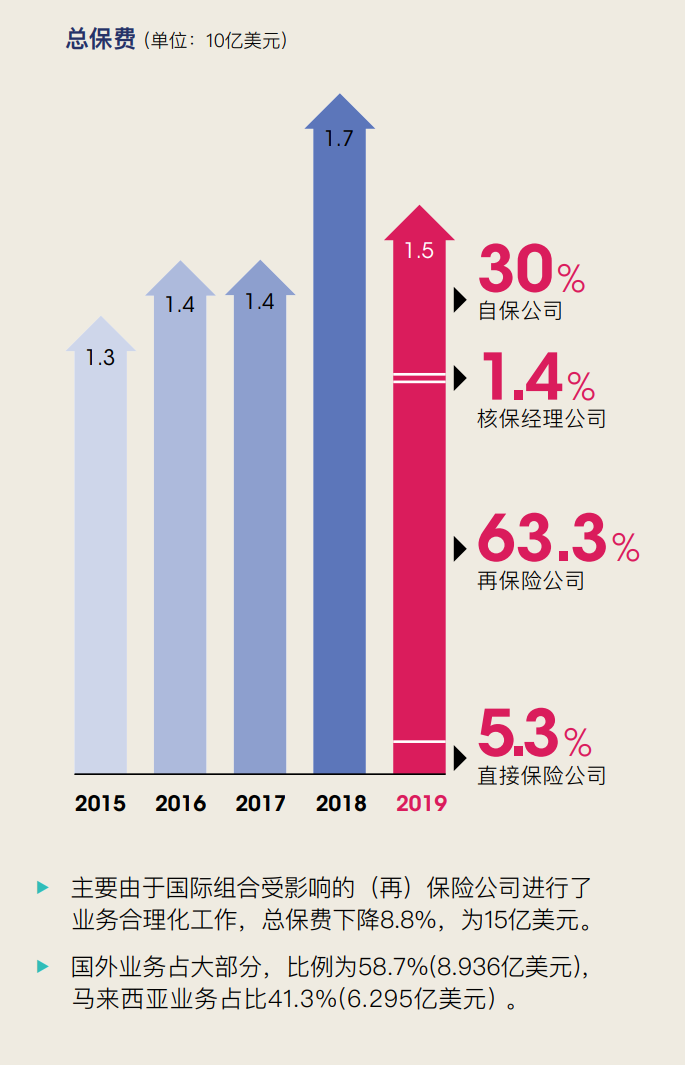
Premium volume in Labuan has generally maintained a growth trend, declining slightly in 2019 owing to the impact of the COVID-19 pandemic. By the end of 2019, total premium income in Labuan had exceeded USD1.5 billion.
From 2014 to 2015, Labuan had a total of 40 captive insurers; the number fell by one in 2016; from 2017 the captive market ended its period of stagnation, adding 4 captive insurers; by 2018 the number reached 48; and by the end of 2019, 52 captive insurers had been established, ranking second in the Asian market and narrowing the gap with Singapore, which ranked first.
Premium income of Labuan captive insurers in 2017-2019 was USD361 million, USD401 million and USD458 million respectively, maintaining sustained and stable growth. In 2019, general liability, engineering, fire, product liability, motor and other insurance accounted for 32.5%, 27.1%, 7.2%, 6.7%, 3.7%, 0.3% and 22.5% of premium income respectively. Engineering and other types of insurance grew fastest, with growth rates of 25.9% and 14.7% respectively.
The rapid development of the captive market in Labuan, Malaysia in recent years has benefited from its flexible captive policies and active marketing strategy. At present, the captive forms permitted in Labuan cover the mainstream captive structures used worldwide, including single-parent captives, group or association captives, protected cell captives, rent-a-captives and even multi-shareholder captives; they may underwrite Malaysian domestic business, may underwrite third-party business on a conditional basis, and may underwrite life insurance business within the parent company.
In addition, Malaysia is Asia's largest Islamic Takaful (re)insurance market, which also gives it a distinctive competitive advantage. By the end of 2018, the Labuan IBFC had 216 licensed insurance entities, with 22 insurance companies, 13 brokerage companies, 2 reinsurance companies and 1 underwriting management company newly added that year, insurance industry assets of USD4.24 billion and total premiums of more than USD1.7 billion, with premiums growing 19.1% over the previous year.
Since 2017, Labuan FSA has actively promoted captive business in China, holding a number of captive promotion events in mainland China, Hong Kong and Singapore. On 19 March 2019, Labuan FSA and the China Banking and Insurance Regulatory Commission signed a memorandum.