Five New Captives in France in 2026: A Wave of Risk Retention by Real-Economy Enterprises Under Policy Tailwinds
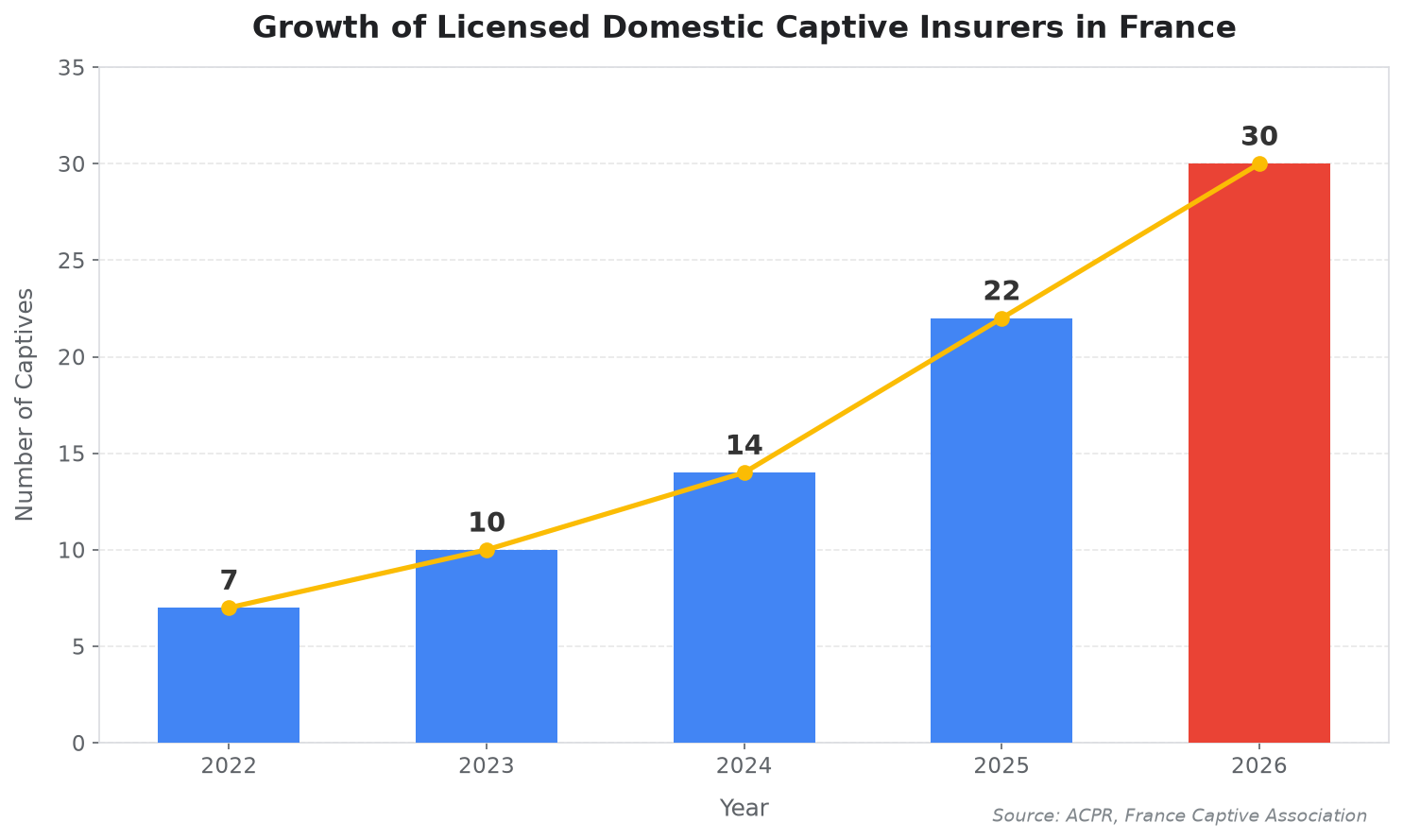
Key Findings: In 2026, the French Prudential Supervision and Resolution Authority (ACPR) approved five new domestic reinsurance captive licences, bringing the total number of licensed domestic captives in France from just 7 at the start of 2022 to 30 today. A policy mix combining tax-advantaged catastrophic resilience reserves and simplified proportional regulation for small and non-complex entities has successfully reversed the long-standing preference of French corporates to domicile their captives in Bermuda or Dublin. Five sectors of the real economy — infrastructure, state-owned logistics, premium tourism, agricultural cooperatives and timber processing — have emerged as the core drivers of this repatriation trend.
I. Policy Background: How France Reactivated Its Domestic Captive Market in Four Years
In recent years the number of domestically domiciled French captives has grown rapidly, from 7 at the beginning of 2022 to 30 today. As of October 2026, following the ACPR's publication of the licence for the last captive of the year (Florence Ré), industry statistics confirm that 2026 has been the year with the largest number of domestic captive approvals in France, with a new entity launching roughly every two months, and nearly ten more industrial group projects currently queued for authorisation.
Two core mechanisms introduced in France's 2023 Finance Act directly triggered the explosive growth of its domestic captive market:
Provision pour Résilience (Resilience Reserve) tax incentive: Up to 90% of a captive's technical profit in any given year may be set aside as a catastrophic reserve on a pre-tax basis, with the total reserve capped at ten times the average minimum capital requirement over the preceding three years. This effectively smooths profit volatility across catastrophe years and delivers deferred tax relief.
Proportional Regulatory Exemption: Reinsurance captives with total assets below €40 billion are classified as "small and non-complex captives" and are exempted from the full set of Solvency II quarterly quantitative reporting requirements. The minimum paid-in capital is only €1.3 million, compared with €3.9 million for a regular reinsurance company, dramatically reducing both compliance and operating costs.
Virtually all French captives take the legal form of a reinsurance captive — the combined result of the regulatory framework, capital requirements, operational complexity, cross-border arrangements and tax policy.
First, Article L.350-2 of the French Insurance Code explicitly defines a domestic captive as a reinsurance captive company: it must be headquartered in France, owned by a non-insurance, non-banking enterprise, and may only provide reinsurance coverage to its parent and affiliated undertakings. In other words, the dominant legal form for a domestic French captive is naturally a reinsurance captive rather than an insurance company that directly underwrites policies.
Second, under Solvency II, the minimum capital requirement for a French reinsurance captive is generally lower than that of a direct insurance captive. A reinsurance captive typically needs €1.2 million in minimum capital, whereas a non-life direct insurance captive needs €2.5 million — a more economical outcome for an entity that primarily assumes risk within its own group.
Third, a reinsurance captive does not need to build the full operational infrastructure of a direct insurance undertaking; functions such as policy issuance, premium collection, claims intake, sales compliance and consumer protection can be handled by a fronting insurance company. The captive concentrates on assuming financial risk, managing capital and arranging reinsurance, which keeps operating costs substantially lower.
Fourth, the "fronting insurance + reinsurance" structure is convenient: group subsidiaries can still purchase policies from locally licensed insurers to meet local regulatory, contractual and compliance requirements, while the fronting insurer then cedes the risk back to the French captive through reinsurance. This preserves the legality of locally issued policies while centralising risk within the group.
Fifth, France's new tax regime has further strengthened the appeal of domestic reinsurance captives. Since 2023, France has introduced the Provision pour Résilience mechanism, allowing captives to set aside part of their earnings as a reserve in order to smooth future claim payouts. This policy has driven a number of French corporates to re-domicile captives previously established in Luxembourg and other jurisdictions, and has encouraged more companies to choose the French reinsurance captive structure from the outset.
In theory, French companies could also set up direct insurance captives and passport them into other EU member states. But for most multinational groups, the capital, governance and operational requirements of a direct insurance captive are higher, so the "reinsurance captive + fronting" model remains the default choice.
II. Overview of the Five New Captives Launched in 2026
In 2026 France added five new captives: Egis Re., launched in February by the Egis engineering and construction group; ASSURAPOSTE RE, launched in March by La Poste Groupe; Barrière, launched in the first half of the year by the Lucien Barrière premium tourism and gaming group; EUREDEN RÉASSURANCE, launched by the Eureden agricultural cooperative; and FLORENCE RÉ, launched in September by the Piveteaubois timber-processing group.
| Approval Date | Captive Entity | Parent Group | Sector | Revenue | Total Assets | Headquarters | GloBE Determination | Core Underwritten Risks |
|---|---|---|---|---|---|---|---|---|
| 2026.02 | EGIS RE SIREN 988799755 | Egis Group | Global infrastructure engineering | Approx. €2.389 billion | Not disclosed | Guyancourt, Yvelines | Above threshold — subject to Pillar Two | Construction-site property damage worldwide, engineering third-party liability, project business interruption, natural catastrophe risks |
| 2026.Q1 | ASSURAPOSTE RE SIREN 922231501 | La Poste Groupe | State-owned logistics & financial services | Over €30 billion | Order of €100+ billion | Paris 15th arrondissement | Well above threshold — subject to Pillar Two | Property damage to the nationwide postal network, express-parcel cargo loss, cyber liability, infrastructure business interruption |
| 2026.H1 | Barrière internal reinsurance SIREN 920867702 | Lucien Barrière Group | Premium tourism & gaming | Approx. €1.2 billion | Not disclosed | Paris 8th arrondissement | Below threshold — not subject | Catastrophe damage to coastal hotels and casinos, guest public liability, business interruption |
| 2026.06 | EUREDEN RÉASSURANCE SIREN 991618257 | Eureden agricultural cooperative | Agri-food processing | Approx. €3.7 billion | Not disclosed | Theix-Noyalo, Brittany | Above threshold — subject to Pillar Two | Farm catastrophes, livestock disease, cold-chain cargo loss, food product liability |
| 2026.09 | FLORENCE RÉ SIREN 102400652 | Piveteaubois Group | Timber processing / wood energy | Approx. €480 million | Not disclosed | Sainte-Florence, Vendée | Below threshold — not subject | Sawmill and CLT factory property damage, fire and storm loss at open-air timber yards, product liability |
All five of these captives are sponsored by non-financial entities: their parent groups span infrastructure, logistics, tourism, agriculture and timber processing — five real-economy sectors — with no banks or insurance companies involved. They fully satisfy the French Insurance Code's definition of a captive as an entity that only assumes internal group risk. All five are classified by the ACPR as small and non-complex, with minimum capital of just €1.3 million, no obligation to submit the full set of Solvency II quarterly reports, and operating costs amounting to roughly one third of those of a traditional offshore captive.
III. Group Background and Shareholder Structure of the Five Captive Parents
A review of each parent's trajectory, industry position, global footprint and governance structure sheds light on the group-level decisions behind setting up their captives.
The five parents cover the full spectrum of French corporate ownership: state-owned groups (La Poste), family enterprises (Piveteaubois and Lucien Barrière), international groups with employee and institutional shareholdings (Egis) and member-owned cooperative organisations (Eureden). Under each structure, the motivations for establishing a captive have common threads — risk retention, cost efficiency and profit stabilisation — but also differ: state-owned and very large groups tend to prioritise risk governance and public functions, while family and cooperative entities are able to make full use of the tax incentives and profit repatriation.
Only La Poste and Lucien Barrière are headquartered in the Paris region: La Poste's headquarters is in the heart of the 15th arrondissement, while Barrière is based in the upscale 8th arrondissement. Egis is headquartered in Guyancourt, Yvelines, to the west of Paris — part of the greater-Paris innovation cluster. Eureden and Piveteaubois are both based in the industrial heartlands of western France (Brittany and Vendée), deeply integrated into their respective agri-food and timber-processing clusters. Each captive is registered at the same address as its parent, reflecting the typical French pattern of "registered domicile identical to industrial headquarters".
The table below summarises the five parents' headquarters, revenue, total assets, workforce and GloBE determination for easy side-by-side comparison.
| Parent Group | Headquarters | Revenue | Total Assets | Workforce | GloBE Determination |
|---|---|---|---|---|---|
| Groupe Egis | Guyancourt, Yvelines, France (15 avenue du Centre) | Approx. €2.389 billion (2025 consolidated) | Not publicly disclosed (unlisted) | Approx. 18,000 employees worldwide | Above threshold — subject to Pillar Two |
| Groupe La Poste | Paris 15th arrondissement, France (9 rue du Colonel Pierre Avia) | Over €30 billion (group consolidated) | Order of €100+ billion (state-owned, public annual report) | Approx. 240,000 employees | Well above threshold — subject to Pillar Two |
| Lucien Barrière | Paris 8th arrondissement, France (33 rue d'Artois) | Approx. €1.2 billion | Not publicly disclosed (family-owned, unlisted) | Approx. 8,000 employees | Below threshold — not subject |
| Groupe Eureden | Theix-Noyalo, Morbihan, Brittany, France (1 Kerlurec) | Approx. €3.7 billion (2024/2025) | Not publicly disclosed (cooperative) | Approx. 8,000 employees | Above threshold — subject to Pillar Two |
| Groupe Piveteaubois | Sainte-Florence, Vendée, France (85140, lieudit La Vallée) | Approx. €480 million (2025) | Not publicly disclosed (family enterprise) | Approx. 450 in France, plus ~1,500 in Poland | Below threshold — not subject |
Note: Revenue figures are taken from the latest publicly available consolidated accounts. Data for La Poste and Egis (which publish annual reports) is considered reliable; figures for unlisted entities such as Lucien Barrière, Piveteaubois and Eureden are estimates based on press reports, and total assets are generally not disclosed separately. All captives themselves have a uniform registered capital of €1.3 million, as already shown in Chapter II.
1. Groupe Egis (parent of EGIS RE)
Background and History
France's leading international infrastructure engineering, design and operations group, evolved from the French state transportation infrastructure engineering system; in recent years it has been transforming into a global full-lifecycle infrastructure service provider.
Its core capabilities cover engineering consultancy, turnkey design, project management and operations concessions, making it one of France's flagships on the global infrastructure market.
Industry Influence
One of France's leading domestic infrastructure engineering consultancies, with a global footprint spanning more than 100 countries.
Involved in landmark projects such as the Hinkley Point C nuclear power station and multiple high-speed rail and transit concessions, with deep expertise in low-carbon and climate-resilient engineering.
Business Areas and Regions
Transport infrastructure (motorways, railways, metros, airports), water infrastructure, energy infrastructure, nuclear ancillaries, urban construction, climate-resilient engineering, full-lifecycle project operations.
Operations across Europe, Africa, the Middle East, Asia-Pacific and the Americas — a major player on the global engineering consultancy market.
Shareholder Background
Not state-controlled; jointly held by employee-shareholders and institutional investors (exact breakdown not yet publicly verified).
2025 consolidated revenue approximately €2.389 billion.
2. Groupe La Poste (parent of ASSURAPOSTE RE)
Background and History
France's state-owned public service group, evolved from the historic French postal and telegraph (PTT) system; the sovereign logistics infrastructure entity of France.
Currently pursuing its "Ambitions 2031" strategy, targeting revenue of €40 billion by 2031.
Industry Influence
Operator of France's national postal network with approximately 17,000 offline branches — a pillar of France's public-service infrastructure.
La Banque Postale and CNP Assurances, both part of the group, form one of France's main bancassurance channels; the logistics arm Geopost is a leading player in European cross-border e-commerce express delivery.
Business Areas and Regions
Postal mail and nationwide postal network, parcel logistics (Geopost / Colissimo, approx. 53% of group revenue), postal banking and insurance (approx. 24% of revenue), Docaposte digital trust services.
Logistics operations across Europe and worldwide; digital services targeting the French and EU markets.
Shareholder Background
State-owned, with strategic oversight by the French Ministry of the Economy; a textbook example of a public-infrastructure state-owned enterprise.
Consolidated group revenue exceeds €30 billion — well above the GloBE threshold.
3. Groupe Lucien Barrière (parent of Barrière internal reinsurance)
Background and History
A century-old, family-controlled premium tourism and gaming group in France, with roots tracing back to the 19th century; the leader of France's domestic casino sector.
Unlisted family business with long-standing expertise in coastal resort destinations and premium leisure.
Industry Influence
One of France's top-tier casino operators, with 18 casinos, 7 five-star luxury hotels, more than 20 premium restaurants plus spa and conferencing operations.
A large concentration of properties on the Côte d'Azur and Atlantic coast — a flagship of France's premium tourism industry.
Business Areas and Regions
Casinos, premium hotels, restaurants, spa and wellness, conferences and exhibitions.
Operations in mainland France and overseas markets including Switzerland and Morocco.
Shareholder Background
Controlled and governed by the Barrière family; unlisted family enterprise (precise equity structure not disclosed).
Consolidated group revenue approximately €1.2 billion.
4. Groupe Eureden (parent of EUREDEN RÉASSURANCE)
Background and History
Leading agricultural and food cooperative in western France's Brittany region, born out of the French agricultural cooperative movement; operates a one-member-one-vote democratic governance model with member ownership.
Unlisted, non-family private enterprise; a benchmark for agricultural supply-chain cooperatives in France.
Industry Influence
One of France's leading agri-food cooperatives, covering the entire supply chain from cultivation and livestock to food processing and retail.
Leader in the French egg market, and number one for lardons (bacon strips).
Business Areas and Regions
Egg processing, fresh meat products, vegetable processing, frozen prepared meals, animal feed, agricultural-input supply, garden retail.
Operations centred on Brittany and western France, extending into other European markets including Spain and Hungary.
Shareholder Background
Held jointly by approximately 17,000 farmer members with democratic governance; profits are returned to members on the basis of their purchase volumes.
Approx. 8,000 employees, 40 production sites and nearly 200 retail outlets; 2024/2025 consolidated revenue approximately €3.7 billion.
5. Groupe Piveteaubois (parent of FLORENCE RÉ)
Background and History
A local family enterprise based in Vendée, France, founded in 1948 by Pierre Piveteau as a carpentry workshop and with its first sawmill built in 1954; over more than 70 years it has grown to become France's leading softwood timber processor.
Expanded overseas with a production site in Poland in 1994, and in 2018 commissioned France's first domestic CLT (cross-laminated timber) production line in Sainte-Florence.
Industry Influence
France's largest softwood sawmill and industrial manufacturer; number one in the French wood-pellet market (350,000 tonnes sold in 2025).
Core supplier to France's low-carbon construction timber supply chain, with products ranging from sawn timber and engineered timber structures (CLT / glulam) to wood-energy pellets.
Business Areas and Regions
Softwood sawing, drying, preservative treatment (DURAPIN technology), engineered timber (CLT brands HEXAPLI / HEXAKIT, glulam Lamwood), wood-energy pellets, outdoor garden and municipal timber products.
Three production sites: Sainte-Florence (Vendée, France), Egletons (Corrèze, France) and Wiele (Poland); products sold into France and international markets.
Shareholder Background
100% controlled by the Piveteau family; Jean Piveteau serves as President, with Catherine and Philippe Piveteau as Managing Directors — a third-generation family business.
Approx. 450 local employees, 2025 consolidated revenue approximately €480 million — below the GloBE threshold, the only mid-sized entity that does not face the global minimum tax.
IV. In-Depth Analysis of Underwritten Risks, Rationale and Operational Impact for Each of the Five Captives
Regardless of group size or industry, the core value of a domestic captive lies in three dimensions: converting external premium expenditure into an internal group risk pool and improving cash flow; enhancing risk-management precision through unified risk control and claims-data feedback; and locking in predictable coverage costs during a hard market cycle, thereby smoothing profit volatility. This section dissects the specific risk exposure each captive assumes, the decision factors involved, and the concrete impacts on the parent group's operations, providing a reference for similar enterprises.
1. EGIS RE (global infrastructure engineering)
Underwritten Risk Pool
Property damage and physical loss on under-construction projects worldwide, covering construction sites in more than 100 countries.
Engineering third-party liability and tort liability on construction projects — long-tail infrastructure risks with high sum-insured and lengthy claims periods.
Project business interruption / delay-in-startup losses relating to major concession assets such as motorways, metros and nuclear ancillary facilities.
Catastrophe losses caused by floods, earthquakes, storms and other natural hazards hitting construction sites and infrastructure.
Freight and damage risk for construction equipment and on-site machinery, plus the retention layer for project liability in overseas emerging markets.
Factors Behind the Decision
Global engineering insurance has entered a hard market cycle, with catastrophe sum-insured being large, risks long-tailed, commercial reinsurance supply contracting, and premiums rising steadily. A captive that assumes the retention layer can smooth premium costs.
Overseas projects are spread across multiple jurisdictions, where local compulsory insurance rules are fragmented; a captive acts as a unified risk-pooling platform to co-ordinate global risk-control standards.
The Provision pour Résilience allows technical profits from catastrophe years to be deferred and set aside, smoothing group-level profit volatility.
Impact on the Parent Group
Reduces premium cash outflows on global projects, improving cost competitiveness in large bidding scenarios.
Unifies risk governance across global subsidiaries, reducing policy fragmentation and claims disputes from multiple insurers.
As the parent revenue exceeds the GloBE threshold, the captive's tax-deferral benefit is partially offset by the global minimum tax, so its risk-management value outweighs its tax benefit.
2. ASSURAPOSTE RE (state-owned postal logistics)
Underwritten Risk Pool
Property damage to approximately 17,000 postal outlets nationwide: fire, storm and flood catastrophes.
Parcel cargo loss in transit, and third-party liability for the postal fleet and outsourced transport capacity.
Employers' liability for staff, and public liability for visitors to postal outlets.
Cyber and data-breach liability (involving Docaposte digital services and La Banque Postale data assets).
Business interruption loss for sorting centres and network infrastructure.
Factors Behind the Decision
The group's outlets and logistics network spread across the whole country: risks are highly dispersed but their total is massive. A captive acting as a central platform consolidates fragmented purchasing and is expected to save around €22 million in external premiums annually.
Aligned with the policy direction of the French Ministry of the Economy, which encourages large public-sector groups to build internal risk-retention mechanisms and strengthen the resilience of sovereign infrastructure.
As a state-owned entity there is no pressure from public listing disclosures; operating costs remain manageable after the proportional regulatory exemption.
Impact on the Parent Group
Transforms dispersed premium expenditure into an internal group risk pool, directly improving cash flow and profit stability.
After unifying risk-control standards, claims data flows back into the group, supporting precision disaster-prevention and operational optimisation decisions.
As a very large state-owned group subject to GloBE, the captive's main contribution is risk management and cost efficiency rather than tax arbitrage.
3. Lucien Barrière internal reinsurance (premium tourism & gaming)
Underwritten Risk Pool
Property damage to 18 casinos, 7 five-star hotels and coastal resort real estate: fire, coastal floods and wildfire catastrophes.
Third-party public liability in high-traffic locations, with marked exposure to facility-accident risks.
Business interruption losses from closed casinos and hotels (the 2024 wildfires on the Côte d'Azur, for example, caused hotel business interruption losses in excess of €15 million).
Damage to specialised electromechanical equipment and gaming assets in casinos, employers' liability and supply-chain logistics risks.
Factors Behind the Decision
Casinos are a high-risk, complex business: international reinsurers impose strict underwriting conditions, high deductibles and sharply rising premiums. A captive can reduce costs in this segment by approximately 30%.
Coastal resort properties are disrupted by extreme weather every year; the Provision pour Résilience allows reserves to be built up during profitable years and drawn down in loss-heavy years, smoothing reported profits.
As an unlisted family enterprise there is no mandatory disclosure requirement; after regulatory simplification operating costs are extremely low.
Impact on the Parent Group
Significantly reduces costs in high-premium insurance segments during a hard market, boosting the net margin and counter-cyclical resilience of the hotel and resort business.
Captive profits are retained within the group, strengthening the family enterprise's capital accumulation and reinvestment capacity.
Provides dedicated coverage for catastrophe-sensitive assets, enabling rapid recovery of the core coastal-tourism business after a disaster.
4. EUREDEN RÉASSURANCE (agri-food cooperative)
Underwritten Risk Pool
Catastrophe losses — storms, floods, hail, wildfires — affecting farms, livestock housing and processing-plant real estate.
Property damage and production interruption related to livestock disease (bio-risks such as avian influenza are among the hardest classes of agricultural insurance to cover).
Cargo loss in agricultural-product warehouses and cold-chain facilities, plus cold-chain interruption loss.
Property damage to agricultural machinery and equipment, transport liability, and food product liability for prepared meals, eggs and meat products.
Business interruption loss across the entire group supply chain from widespread disaster or disease.
Factors Behind the Decision
Commercial agricultural insurance imposes high deductibles and sum-insured caps on diseases and contiguous meteorological catastrophes; the captive assumes the tail catastrophe losses that external insurance does not cover.
Agricultural yields and profits swing wildly between disaster and good years; the Provision pour Résilience can smooth payouts across cycles, stabilising the purchase prices and dividends paid to member farmers.
Co-ordinates unified disaster-prevention and disease-control measures across farms and processing plants in Brittany, western France, Spain and Hungary.
Impact on the Parent Group
Strengthens the cooperative's resilience against extreme weather and disease shocks, guaranteeing stable purchase and dividend payments to 17,000 members.
Captive profits ultimately flow back to member farmers, creating a sustainable agricultural-industry benefit mechanism and reinforcing cooperative loyalty.
With group revenue above the GloBE threshold, risk-protection value takes precedence over tax benefit — yet it remains a replicable reference for agricultural-industrial entities.
5. FLORENCE RÉ (timber processing / wood energy)
Underwritten Risk Pool
Property damage to buildings, long-span steel structures and production equipment at the three production sites in France (Vendée, Corrèze) and Poland.
Fire and storm loss at open-air log yards and finished-timber warehouses (timber is stored in high stacks and highly flammable, so commercial insurance underwriting conditions are demanding).
Catastrophe wind losses from three consecutive powerful storms (Benjamin, Goretti, Nils) that battered western France in winter 2025-2026.
Product liability for CLT cross-laminated timber and glulam used in residential and public buildings.
Business interruption loss from shutdowns at sawmills and pellet plants, plus cross-border timber transport cargo loss.
Factors Behind the Decision
Timber processing is a high-risk class of business; western France property-insurance premiums for timber and open-air yard assets rose by more than 50% between 2023 and 2026. A captive assuming the retention layer smooths the cost.
Group revenue of €480 million is below the GloBE threshold, so it can enjoy 100% of the Provision pour Résilience deferred-tax benefit — a win-win for both tax and risk control.
Co-ordinates unified disaster-prevention, fire and storm-resistance upgrades across the three cross-border production sites, replacing the fragmented insurance-policy model.
Impact on the Parent Group
Provides dedicated coverage for high-risk assets such as open-air yards and CLT factories, significantly reducing premium cash outflows and the group's own retention of catastrophe risk.
Profits deferred into the reserve directly improve the family enterprise's after-tax cash flow and reinvestment capacity.
As the only mid-sized entity not subject to GloBE, it maximises the benefit of domestic captive tax incentives and is the ideal benchmark for mid-sized manufacturing enterprises.
V. Rising Insurance Premiums in France and Globally in Recent Years — and Their Role in Driving These Five Captive Decisions
Since 2023, Europe has entered a new hard cycle in property insurance. Rising premiums combined with catastrophe losses are the core external driver behind this wave of captive formations by French groups. This chapter summarises market premium data and analyses how rising premiums translated into captive-setup decisions for each group.
1. Key Data on Rising Premiums in France and Globally
| Indicator | Figure | Source and Notes |
|---|---|---|
| Cumulative increase in European catastrophe reinsurance premiums | Up approximately 75% since 2017 | EIOPA / ECB 2024 joint report: European property catastrophe reinsurance premiums have risen continuously since 2017, with 2022-2024 as the acceleration phase. |
| Annual increase in French commercial insurance premiums | 5%-8% annually since 2023 | Mordor Intelligence: French commercial property, fire, cyber and liability lines have been raised for three consecutive years; global reinsurers are withdrawing capacity. |
| Cumulative increase in French residential insurance premiums | +44% since 2019 | lecomparateurassurance.com: +17% in 2023, +24% in 2024, +37% in 2025, +44% in 2026 — never retreating year-on-year. |
| French residential insurance increases, 2025-2026 | +11%-12.8% in 2025; forecast +7%-8% in 2026 | France Assureurs and Addactis forecasts; high-climate-risk regions see increases of 10%-15%. |
| French CatNat surcharge | Raised from 12% to 20% in January 2025 (first increase in 25 years) | Decree of 22 December 2023; approximately €1.5 billion of additional annual indemnity capacity, passed on to policyholders. |
| Annual French catastrophe losses | €10.6 billion in 2022, €6.5 billion in 2023, €8.0 billion in 2024 | 4.6 million claims in 2024, of which €5 billion were climate-related; 2024 was the ninth-costliest year of the CatNat system since its 1982 launch. |
| Engineering insurance premium increases | +5%-30% for engineering umbrella / excess-of-loss liability in 2026 | Mordor engineering insurance report: Zurich Global Specialty Construction rose +18% in H1 2026 YoY; social inflation and large judgments are pushing up capacity prices in North America and Europe. |
| ICC construction cost index | +7.22% YoY in Q1 2024 | Rising costs of construction materials, steel, timber and energy directly drive up claim costs and reinstatement values. |
| AM Best outlook for French non-life insurance | Negative outlook | July 2025 report: 2023-2024 premium increases are still insufficient to cover claims inflation, and further rises are needed in 2025. |
2. How Rising Premiums Specifically Drove Each Captive Decision
The fact that all five captives were approved in 2026 is fundamentally the product of the resonance between a hard market cycle and policy tailwinds.
Transmission path from rising premiums to captive formation: ? European catastrophe reinsurance premiums have risen 75% cumulatively since 2017, and the 2025 CatNat surcharge hike (from 12% to 20%) — the first major increase in 25 years — has directly pushed up the base cost of all property-insurance policies; ? high-risk sectors (engineering, coastal tourism, agriculture, timber processing) face a triple squeeze of "premium jumps + underwriting tightening + partial uninsurability"; ? corporates are shifting from "fully outsourcing insurance" to a layered risk architecture where "the retention layer is assumed by a captive while external insurance only buys catastrophe excess-of-loss"; ? the Provision pour Résilience tax incentive and ACPR proportional exemption, both introduced by France in 2023, arrived precisely in this cycle window, making domestic captives more cost-effective than offshore alternatives.
2.1 EGIS RE (infrastructure engineering)
Direct pressure: Global construction umbrella / excess-of-loss liability premiums rose 5%-30% in 2026; per-day indemnity caps under project delay clauses have risen to $500,000; overseas emerging-market engineering reinsurers are withdrawing from high-risk projects.
Captive response: By having EGIS RE assume the retention layer, the premiums that would have been paid to international reinsurers are converted into an internal group risk pool, smoothing the year-on-year volatility of premiums for cross-border project budgets.
Decision impact: The hard market cycle was the immediate trigger for Egis setting up its captive in February 2026 — soaring project insurance costs forced the group to shift from external insurance purchasing to internal risk retention.
2.2 ASSURAPOSTE RE (state-owned postal)
Direct pressure: The group's 17,000 nationwide postal outlets represent a highly concentrated property exposure; the CatNat surcharge jumped from 12% to 20% in 2025, forcing up the base premiums on all property policies; in 2025 cyber liability was made compulsory, adding approximately 6% to commercial premiums.
Captive response: ASSURAPOSTE RE centrally assumes the retention layer for outlet property, parcel cargo loss and cyber liability, with estimated annual savings of approximately €22 million in external premiums.
Decision impact: As a state-owned entity, the French Ministry of the Economy pushed it to establish an internal risk-retention mechanism; the premium rises further validated the cost-effectiveness of a centralised captive.
2.3 Lucien Barrière (premium tourism & gaming)
Direct pressure: Coastal hotels and casinos form a high-risk, complex business: wildfires and flood catastrophes are frequent in the south of France; the 2024 wildfires caused more than €15 million in hotel business interruption losses on the Côte d'Azur; a trend of "uninsurability" has already emerged in high-risk regions of France, with insurers sharply raising deductibles and limiting cover in coastal departments.
Captive response: The captive assumes the tail catastrophe risks that external insurance does not cover; the Provision pour Résilience allows reserves to be built up in profitable years and drawn down in disaster years, stabilising group profits; modelling suggests this reduces insurance costs in the relevant segments by approximately 30%.
Decision impact: The direct 2024 wildfire losses were the critical event that pushed the Barrière family to complete captive approval by the end of 2025.
2.4 EUREDEN RÉASSURANCE (agricultural cooperative)
Direct pressure: Drought accounts for more than 50% of European agricultural climate losses; commercial agricultural insurance imposes high deductibles and sum-insured caps on diseases and contiguous catastrophes; under the CAP subsidy framework premiums still rise every year (Austria's 2025 agricultural premium subsidy of €160 million is +10% YoY); after France established its three-tier agricultural risk-management system in 2022, there remains a clear coverage gap for tail catastrophes.
Captive response: EUREDEN RÉASSURANCE assumes disease, contiguous storm and cold-chain interruption risks not covered by commercial insurance; cross-cycle reserve adjustment stabilises the purchase payments made to its 17,000 member farmers.
Decision impact: The structural supply shortfall in the agricultural insurance market (not merely rising premiums) was the fundamental reason for setting up the captive — it complements rather than replaces commercial agricultural insurance.
2.5 FLORENCE RÉ (timber processing)
Direct pressure: Timber processing is a high-risk class; western France property-insurance premiums for timber and open-air yard assets rose by more than 50% between 2023 and 2026; three consecutive powerful storms (Benjamin, Goretti, Nils) in the winter of 2025-2026 battered western France's forestry industry, with wind losses concentrated at open-air log yards and long-span steelwork factories.
Captive response: Florence Ré assumes the retention layers for fire damage, storm losses and product liability across the three cross-border production sites; Piveteaubois revenue is below the GloBE threshold, so it can enjoy the full Provision pour Résilience tax incentive — a win-win for both tax and risk control.
Decision impact: Approved in September 2026, just before the winter-storm peak season, it is a proactive choice by the group to lock in predictable risk costs in the new hard market cycle.
VI. Implications for China's Captive Market
Tax incentives combined with deregulation are the core levers for activating a domestic captive market: France's practice proves that just one pre-tax-deduction policy for catastrophic reserves, together with a proportional regulatory exemption for small captives, can triple the number of domestic captives within four years — without copying the zero-rate model of offshore jurisdictions.
Mid-sized real-economy enterprises are the mainstay of a captive market, not just mega-groups: The five captives added in France in 2026 have parents with revenue ranging from €480 million to €30 billion, with most being mid-sized manufacturing, agricultural or tourism enterprises with annual revenue of €500 million to €4 billion. These corporates have limited bargaining power in the traditional insurance market and are highly premium-sensitive — the very group that domestic captive policy should target.
In the GloBE era, onshore jurisdictions have comprehensively overtaken offshore ones in competitiveness: As offshore jurisdictions such as the Cayman Islands and BVI — which have not yet implemented QDMTT — face the risk of future UTPR top-up tax clawbacks, jurisdictions that have already implemented a qualified minimum tax while preserving domestic tax incentives, such as France and Hong Kong, are becoming the preferred choice for global corporates setting up captives.
Sector diffusion is an inevitable trend: In the past the captive market was concentrated in energy and shipping, but France's 2026 example has expanded into agricultural cooperatives, timber processing, premium tourism and postal logistics — sectors traditionally considered less risky. In the future, China's forestry, state farms, tourism resorts and infrastructure-outbound groups all have the potential to set up domestic captives.
Source: China Captive