
France Adds Five New Captives in 2026: A Wave of Risk Self-Retention by Real-Economy Corporates Under Policy Incentives
Core conclusion: In 2026 the French Prudential Supervision and Resolution Authority (ACPR) approved a total of five domestic reinsurance captive licences over the full year, lifting the total number of licensed domestic captives in France from seven at the start of 2022 to 30. The policy package — combining a tax incentive for the resilience catastrophe reserve with simplified supervision for small and non-complex entities — has successfully reversed the traditional preference of French corporates to domicile their captives in Bermuda or Dublin, with five real-economy sectors — infrastructure, state-owned logistics, high-end tourism and gaming, agricultural cooperatives and timber processing — becoming the main drivers of the return flow.
I. Policy Background: How France Activated Its Domestic Captive Market in Four Years
In recent years the number of domestic captives in France has grown rapidly, from seven at the start of 2022 to 30 today.As of October 2026, following the publication of the ACPR's last captive licence of the year (Florence Ré), industry statistics confirm that 2026 is the year with the highest number of domestic captive approvals in France, with a new entity established roughly every two months, while close to 10 industrial group projects are queued awaiting approval.
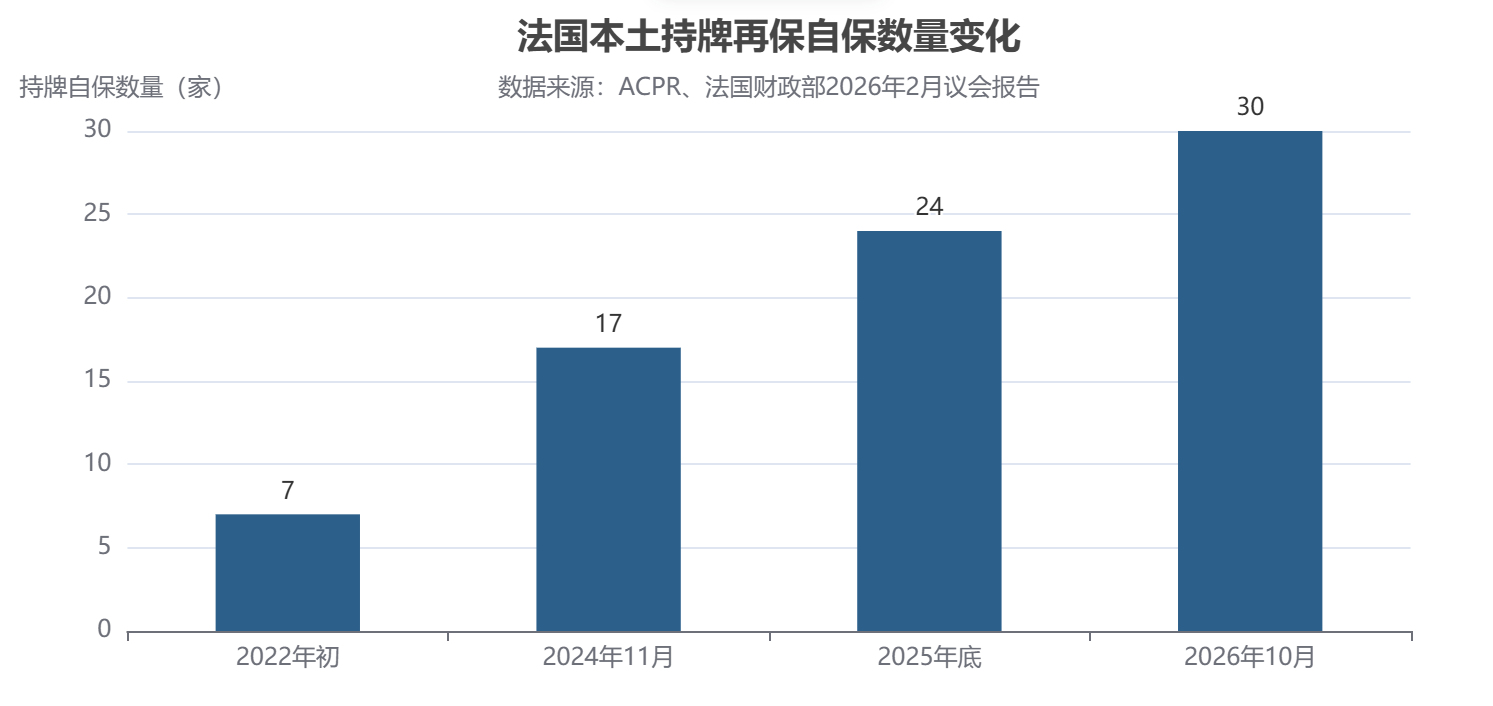
The 2023 French Finance Act introduced two core measures that directly drove the explosive growth of the domestic captive market:
-
Resilience reserve (Provision pour Résilience) tax incentive: 90% of a captive's technical profit for the year may be set aside pre-tax as a catastrophe reserve, with total reserves capped at 10 times the average minimum capital requirement of the last three years, effectively smoothing profit volatility in catastrophe years and delivering tax deferral.
-
Proportionality supervisory exemption: reinsurance captives with assets below €4 billion are recognised as “small non-complex captives”, exempt from the full set of Solvency II quarterly quantitative reporting templates, with a minimum paid-in capital of only €1.3 million (compared with €3.9 million for ordinary reinsurance companies), substantially reducing compliance and operating costs.
French captives generally adopt the “reinsurance captive” form, mainly as aresult of the combined effect of the regulatory framework, capital requirements, operational complexity, cross-border arrangements and tax policy.
First, Article L.350-2 of the French Insurance Code defines a domestic captive explicitly as areinsurance captive company: headquartered in France, held by a non-insurance/non-banking corporate, and permitted to provide reinsurance cover only to its parent and affiliated companies. In other words, the mainstream legal form of a French domestic captive is inherently a “reinsurance captive” rather than an insurance company that issues policies directly.
Second, under the Solvency II framework the minimum capital requirement for French reinsurance captives is generally lower than that for direct-writing captives. Reinsurance captives typically require€1.2 million, whereas non-life direct insurance captives typically require€2.5 million. This is more economical for companies that mainly assume intra-group risks.
Third, a reinsurance captive does not need to build a complete direct insurance operating system: processes such as policy issuance to end customers, premium collection, claims intake, sales compliance and consumer protection can all be handled by the fronting insurer. The captive mainly takes onfinancial risk assumption, capital management and reinsurance arrangements, with lower administrative costs.
Fourth, itfacilitates a “fronting + reinsurance” structure.Group subsidiaries can still buy policies from locally licensed insurers, satisfying local regulatory, contractual and compliance requirements; the fronting insurer then cedes the risk back to the French captive by way of reinsurance. This preserves the legal validity of the local policies while concentrating the risk within the group.
Fifth,the new French tax regime has reinforced the appeal of domestic reinsurance captives.In 2023 France introduced the “resilience reserve” mechanism, allowing captives to set aside part of their profits as a reserve to smooth future claims. This policy has prompted a number of French companies to relocate captives originally domiciled in Luxembourg and elsewhere back to France, and has encouraged more companies to choose the French reinsurance captive structure.
In theory France can also establish direct insurance captives, which can write business in other Member States through the EU passport. However, for most multinational groups the capital, governance and operational requirements of a direct insurance captive are higher, soreinsurance captive + fronting arrangementis more commonly used.
II. Overview of the Five New Captives in 2026
In 2026 France added five new captives: Egis Re., established in February by the Egis engineering and construction group; ASSURAPOSTE RE, established in March by the La Poste group; established in June by Lucien Barrière, the tourism and gaming group, as Barriè Re; established by the Eureden agricultural cooperative as EUREDEN RÉASSURANCE; and established in September by the timber processing company Piveteaubois group as FLORENCE RÉ.
|
Licence date |
Captive entity |
Parent company |
Sector |
Revenue |
Total assets |
Headquarters |
GloBE status |
Core underwriting risks |
|---|---|---|---|---|---|---|---|---|
|
2026.02 |
EGIS RE SIREN 988799755 |
Egis Group |
Global infrastructure engineering |
Approx. €2.389 billion |
Not disclosed |
Guyancourt, Yvelines |
Above threshold, subject to Pillar Two |
Property insurance at construction sites worldwide, engineering third-party liability, project business interruption, natural catastrophe |
|
2026.Q1 |
ASSURAPOSTE RE SIREN 922231501 |
La Poste Group |
State-owned logistics and financial services |
Over €30 billion |
Of the order of €100 billion |
15th arrondissement, Paris |
Far above threshold, subject to Pillar Two |
Property insurance across the nationwide branch network, parcel cargo damage, cyber liability, infrastructure business interruption |
|
2026.H1 |
Barrière internal reinsurance SIREN 920867702 |
Lucien Barrière Group |
High-end tourism and gaming |
Approx. €1.2 billion |
Not disclosed |
8th arrondissement, Paris |
Below threshold, not subject to it |
Catastrophe property losses at coastal hotels and casinos, guest public liability, business interruption |
|
2026.06 |
EUREDEN RÉASSURANCE SIREN 991618257 |
Eureden agricultural cooperative |
Agri-food processing |
Approx. €3.7 billion |
Not disclosed |
Theix-Noyalo, Brittany |
Above threshold, subject to Pillar Two |
Farm catastrophe, livestock and poultry disease, cold-chain cargo damage, food product liability |
|
2026.09 |
FLORENCE RÉ SIREN 102400652 |
Piveteaubois Group |
Timber processing / wood energy |
Approx. €480 million |
Not disclosed |
Sainte-Florence, Vendée |
Below threshold, not subject to it |
Property insurance at sawmills and CLT plants, fire damage in open-air yards, storm catastrophe, product liability |
All five of these companies are led by non-financial entities: their parent companies cover five real-economy tracks — infrastructure, logistics, tourism and gaming, agriculture and timber processing — with no banks or insurance-type financial institutions, fully consistent with the definition of a captive under the French Insurance Code as an entity that “assumes intra-group risks only”. All five are recognised by the ACPR as small non-complex entities, with minimum capital of only €1.3 million, no obligation to submit the full set of Solvency II quarterly reports, and operating costs of only one third of those of a traditional offshore captive.
III. Group Background and Shareholding Structure of the Five Captives' Parent Companies
Starting from each of the five parents' group history, industry position, global business footprint and equity governance structure, it is easier to understand the group-level decision context behind establishing a captive.
The five parent companies span the mainstream ownership forms of French business — a state-owned group (La Poste), family-owned companies (Piveteaubois, Lucien Barrière), an international group held by employees and institutional investors (Egis), and a member-owned cooperative organisation (Eureden). Under different ownership structures, the objectives of establishing a captive share common features (risk retention, cost consolidation, profit stability) but also differ: state-owned and very large groups place more emphasis on risk governance and public functions, while family-owned and cooperative entities are better able to capture the full benefit of tax incentives and profit repatriation.
Of the five companies, only La Poste and Lucien Barrière have their headquarters in the Greater Paris region: La Poste is headquartered in the core of the 15th arrondissement of Paris and Barrière in the upmarket commercial district of the 8th arrondissement. Egis is headquartered in Guyancourt, Yvelines, west of Paris, part of the innovation and technology cluster on the outskirts of the Greater Paris metropolitan area. Eureden and Piveteaubois are both headquartered in the industrial heartland of western France outside the Paris region (Brittany and the Vendée), deeply tied to their respective agri-food and timber processing clusters; the captive's place of registration accordingly coincides with the group's head office, reflecting the typical characteristic of French domestic captives that “the registered office is at the same address as the industrial headquarters”.
The following table summarises the headquarters location, revenue, total assets, headcount and GloBE threshold determination of the five parent companies for horizontal comparison.
|
Parent company |
Headquarters |
Revenue |
Total assets |
Headcount |
GloBE status |
|---|---|---|---|---|---|
|
Groupe Egis |
Guyancourt, Yvelines, France (15 avenue du Centre) |
Approx. €2.389 billion (2025, consolidated) |
Not publicly disclosed (unlisted) |
Approx. 18,000 worldwide |
Above threshold, subject to Pillar Two |
|
Groupe La Poste |
15th arrondissement, Paris, France (9 rue du Colonel Pierre Avia) |
Over €30 billion (group consolidated) |
Of the order of €100 billion (state-owned group, public annual report) |
Approx. 240,000 |
Far above threshold, subject to Pillar Two |
|
Lucien Barrière |
8th arrondissement, Paris, France (33 rue d'Artois) |
Approx. €1.2 billion |
Not publicly disclosed (family-owned, unlisted) |
Approx. 8,000 |
Below threshold, not subject to it |
|
Groupe Eureden |
Theix-Noyalo, Morbihan, Brittany, France (1 Kerlurec) |
Approx. €3.7 billion (2024/2025) |
Not publicly disclosed (cooperative) |
Approx. 8,000 |
Above threshold, subject to Pillar Two |
|
Groupe Piveteaubois |
Sainte-Florence, Vendée, France (85140, lieudit La Vallée) |
Approx. €480 million (2025) |
Not publicly disclosed (family-owned company) |
Approx. 450 in France, and approx. 1,500 including Poland |
Below threshold, not subject to it |
(Note:Data note: revenue figures are compiled on the latest publicly disclosed consolidated basis; for La Poste, Egis and others with public annual reports the data is more reliable, while revenue for unlisted entities such as Lucien Barrière, Piveteaubois and Eureden is an estimate based on public reporting, and total assets are mostly not disclosed separately; the precise figures are subject to the companies' official financial statements. The registered capital of the captive entities themselves is uniformly €1.3 million and is set out in the table in Chapter 2.)
1. Groupe Egis (parent of EGIS RE)
Group background and history
-
A leading French international infrastructure engineering consultancy, design and operations group, descended from the French national transport infrastructure engineering system, which in recent years has been transforming into a full-lifecycle infrastructure service provider worldwide
-
Its core capabilities cover engineering consultancy, design lead contracting, project management and operations concessions; it is one of France's calling cards in the international infrastructure market
Industry influence
-
One of the leading domestic infrastructure engineering consultancies in France, with a global network covering more than 100 countries
-
It has taken part in landmark projects such as the Hinkley Point C nuclear power station and highway and rail transit concessions in several countries, with deep expertise in low-carbon and climate-resilience engineering
Business scope and regions
-
Transport infrastructure (highways, railways, metros, airports), water, energy infrastructure, nuclear support facilities, urban buildings, climate-resilience engineering and full-lifecycle project operations and maintenance
-
Operations across Europe, Africa, the Middle East, Asia-Pacific and the Americas; a major participant in the global engineering consultancy market
Shareholder background
-
Not state-controlled; held jointly by employee shareholders and institutional investors (the ownership structure is not purely state-owned, and the exact shareholdings are subject to public disclosure and verification)
-
Consolidated group revenue of approximately €2.389 billion in 2025
2. Groupe La Poste (parent of ASSURAPOSTE RE)
Group background and history
-
A French state-owned public service group, descended from the long-established French postal and telecommunications (PTT) system and the backbone of France's sovereign logistics infrastructure
-
It is implementing its “Ambitions 2031” strategy, targeting revenue of €40 billion by 2031
Industry influence
-
Operator of the nationwide French postal network, covering approximately 17,000 physical branches and a pillar of France's essential public services infrastructure
-
Its La Banque Postale and CNP Assurances form one of France's main bancassurance channels, and its logistics arm Geopost is a leading European cross-border e-commerce parcel carrier
Business scope and regions
-
Postal mail and the nationwide branch network, parcel logistics (Geopost/Colissimo, about 53% of group revenue), postal banking and insurance (about 24% of revenue), and Docaposte digital trust services
-
Logistics operations cover Europe and the rest of the world, while digital services address the French and EU markets
Shareholder background
-
A state-owned group in which the French state holds a stake, with its strategy supervised by the French Ministry of Finance; a representative state-owned public infrastructure entity
-
Consolidated group revenue of over €30 billion, far above the GloBE threshold
3. Groupe Lucien Barrière (parent of Barrière internal reinsurance)
Group background and history
-
A century-old French family-controlled high-end tourism and gaming group whose business dates back to the 19th century; a leader in the domestic French casino segment
-
A family-owned, unlisted company long established in coastal resorts and high-end leisure
Industry influence
-
In the first tier of French domestic casino operators, with 18 casinos, seven five-star luxury hotels, more than 20 upscale restaurants together with spa and conference and exhibition operations
-
A large part of its property is concentrated in coastal resort areas such as the Côte d'Azur and the Atlantic coast; a showcase of French high-end tourism
Business scope and regions
-
Casinos, high-end hotels, restaurants, spa and wellness, conferences and exhibitions
-
Operations in mainland France and in overseas markets including Switzerland and Morocco
Shareholder background
-
Controlled and led in governance by the Barrière family; an unlisted family business (the detailed ownership structure is not publicly disclosed)
-
Consolidated group revenue of approximately €1.2 billion
4. Groupe Eureden (parent of EUREDEN RÉASSURANCE)
Group background and history
-
A leading agri-food cooperative in Brittany, western France, which grew out of the French agricultural cooperative movement and operates on a democratically governed, member-owned cooperative model
-
Unlisted and not a family-owned private company; a benchmark entity among French agricultural supply chain cooperatives
Industry influence
-
One of the leading cooperatives in the French agri-food industry, covering the entire chain from crop growing and livestock rearing to food processing and retail
-
It leads the French egg market and ranks first in France in the bacon (lardons) category
Business scope and regions
-
Egg and poultry processing, fresh meat and charcuterie, vegetable processing, frozen prepared meals, animal feed, farm input supply and garden retail
-
Operations centred on Brittany and western France, extending to European markets including Spain and Hungary
Shareholder background
-
Owned jointly by approximately 17,000 farmer members, with democratic one-member-one-vote governance and profits returned to farmers according to volumes delivered
-
Approximately 8,000 employees, 40 production sites and close to 200 retail stores; consolidated revenue of approximately €3.7 billion in 2024/2025
5. Groupe Piveteaubois (parent of FLORENCE RÉ)
Group background and history
-
A local family business in the Vendée department of France, founded in 1948 by Pierre Piveteau as a woodworking workshop, with a sawmill built in 1954; over more than 70 years it has grown into a French leader in softwood industrial processing
-
It established a production base in Poland in 1994 and in 2018 commissioned France's first domestic CLT cross-laminated timber production line in Sainte-Florence
Industry influence
-
France's largest softwood sawmilling and industrial manufacturer, and number one in the French wood pellet fuel market (350,000 tonnes sold in 2025)
-
A core company in France's low-carbon construction timber supply chain, with products covering sawn timber, engineered timber structures (CLT/glulam) and wood energy pellets
Business scope and regions
-
Softwood sawn timber, kiln drying, preservative treatment (DURAPIN technology), engineered timber structures (CLT brands HEXAPLI/HEXAKIT, Lamwood glulam), wood pellets, and outdoor garden and transport and municipal timber products
-
Three production sites: Sainte-Florence in the Vendée (France), Egletons in the Corrèze (France) and Wiele (Poland); products sold in France and on international markets
Shareholder background
-
100% owned by the Piveteau family, with Jean Piveteau as Chairman and Catherine and Philippe Piveteau as Managing Directors, across three generations of family succession
-
The group employs approximately 450 people in France and reported consolidated revenue of approximately €480 million in 2025; below the GloBE threshold, it is the only mid-sized entity not subject to the global minimum tax.
IV. In-Depth Analysis of the Five Captives' Underwriting Risks, Establishment Considerations and Business Impact
Whatever the size and sector of the group, the core business value of establishing a domestic captive is reflected at three levels — first, converting external premium spending into an intra-group risk pool and improving cash flow; second, enhancing the precision of risk management through unified risk control and claims data feedback; third, locking in predictable protection costs and smoothing profit volatility during hard market cycles.This section examines company by company the specific risk exposures borne by the five captives, the decision factors behind each group's establishment of a captive, and the actual impact that the captive has had on the parent's business, providing a decision-making reference for comparable companies.
1. EGIS RE (global infrastructure engineering)
Underwriting risk pool
-
Physical damage and material loss at construction sites of projects under construction worldwide, covering construction projects in more than 100 countries
-
Engineering third-party liability and construction tort liability; long-tail infrastructure risks with large limits and long claims settlement cycles
-
Project business interruption / delayed opening losses, involving large concession assets such as highways, metros and nuclear support facilities
-
Catastrophe losses to construction sites and infrastructure caused by natural perils such as flood, earthquake and storm
-
Cargo and damage risks for construction equipment and on-site machinery, and the retained project liability layer in overseas emerging markets
Establishment considerations
-
Global engineering insurance has entered a hard market cycle, with large catastrophe limits, long-tail risks, shrinking commercial reinsurance capacity and persistently rising rates; a captive assuming the retained layer can smooth premium costs
-
Overseas projects are spread across multiple jurisdictions where local compulsory insurance rules are fragmented; the captive serves as a unified risk aggregation platform to coordinate global risk control standards
-
Using the resilience reserve to defer the recognition of technical profit in catastrophe years, smoothing group profit volatility
Impact on the parent's business
-
Reduces premium cash outflow on global projects and improves the cost competitiveness of large tender bids
-
Unifies risk governance across subsidiaries worldwide and reduces the wording differences and claims friction caused by multiple separate placements
-
The parent's revenue exceeds the GloBE threshold, so the captive's tax deferral benefit is partly offset by the global minimum tax; the risk control value outweighs the tax benefit
2. ASSURAPOSTE RE (state-owned postal logistics)
Underwriting risk pool
-
Property insurance for real estate at approximately 17,000 postal branches nationwide: fire, storm and flood catastrophe
-
Cargo damage in express parcel transport, and motor third-party liability for the postal fleet and outsourced transport capacity
-
Employers' liability insurance for employees and public liability for branch visitors
-
Cyber and data breach liability risk (involving Docaposte digital services and La Banque Postale data assets)
-
Business interruption losses at sorting centres and network infrastructure
Establishment considerations
-
The group's branches and logistics routes span the whole country, with highly dispersed risk but a very large aggregate; the captive acts as a unified middle office consolidating fragmented procurement and is expected to save approximately €22 million of premium each year
-
It aligns with the French Ministry of Finance's policy direction of encouraging large public groups to establish internal risk retention mechanisms and strengthen the risk resilience of sovereign infrastructure
-
As a state-owned entity it faces no listed-company disclosure pressure, and operating costs are manageable following the proportionality exemption
Impact on the parent's business
-
Converts dispersed premium spending into an intra-group risk pool, directly improving cash flow and profit stability
-
Once risk control standards are unified, claims data flows back to the group, supporting precise loss prevention and operational optimisation decisions
-
As a very large state-owned group subject to GloBE, the captive's main contribution is risk management and cost consolidation rather than tax arbitrage
3. Lucien Barrière internal reinsurance (high-end tourism and gaming)
Underwriting risk pool
-
Property insurance for 18 casinos, seven five-star hotels and coastal resort properties: fire, coastal flood and wildfire catastrophe
-
Public third-party liability insurance in locations with high visitor density, with pronounced exposure to facility accident risk
-
Business interruption losses from the closure of casinos and hotels (wildfires in southern France in 2024 caused more than €15 million of closure losses for Côte d'Azur hotels)
-
Risk of damage to specialised casino electromechanical equipment and gaming assets, employers' liability and back-office supply chain risk
Establishment considerations
-
Casinos are a high-risk composite business; international reinsurance terms are stringent, deductibles are high and rate increases significant, and a captive can reduce costs in the relevant segment by approximately 30%
-
Coastal resort assets are affected by extreme weather every year; the resilience reserve allows reserves to be set aside in profitable years and drawn down in heavy loss years, smoothing book profit
-
As an unlisted family-owned entity it faces no mandatory disclosure pressure, and operating costs are extremely low after regulatory simplification
Impact on the parent's business
-
Significantly reduces the cost of the high-rate insurance segment in a hard market, improving net margin and cyclical resilience of the hotel and resort business
-
Captive profits are retained within the group, strengthening the family business's capital accumulation and reinvestment capacity
-
Creates dedicated protection for catastrophe-sensitive assets, safeguarding the rapid recovery of core coastal tourism assets after a disaster
4. EUREDEN RÉASSURANCE (agri-food cooperative)
Underwriting risk pool
-
Catastrophe losses from storm, flood, hail, wildfire and other perils at farms, livestock buildings and processing plants
-
Property losses and production interruption related to livestock and poultry disease (biological risks such as avian influenza are the hardest class for agricultural insurance to underwrite)
-
Cargo damage and cold chain interruption losses at agricultural produce storage and cold chain facilities
-
Property insurance for agricultural machinery and equipment, transport liability, and food product liability insurance for prepared meals, egg products and meat products
-
Business interruption losses from the shutdown of the group's entire supply chain due to large-scale disaster or disease
Establishment considerations
-
Commercial agricultural insurance imposes high deductibles and capped limits for disease and widespread weather catastrophe; the captive assumes the tail catastrophe losses not covered by external insurance
-
Agricultural harvests and profits in disaster years fluctuate greatly; the resilience reserve allows cross-cycle adjustment, stabilising the purchase payments and dividends paid to farmers
-
Coordinating unified loss prevention and disease control risk management across farms and processing plants in Brittany, western France, Spain and Hungary
Impact on the parent's business
-
Strengthens the cooperative's ability to withstand extreme weather and disease shocks, safeguarding stable purchase payments and dividend distribution to 17,000 members
-
The captive's underwriting results ultimately flow back to the farms, creating a sustainable mechanism through which the value chain supports agriculture and strengthening cooperative members' loyalty
-
Group revenue exceeds the GloBE threshold, so the value of risk protection takes priority over tax benefits, but the case remains a replicable model for agricultural industrialisation entities
5. FLORENCE RÉ (Timber Processing / Wood Energy)
Underwriting Risk Pool
-
Property insurance for the plants, long-span steel structures and production equipment at three production sites in France (Vendée, Corrèze) and Poland
-
Fire and storm losses at open-air log yards and finished-timber warehouses (timber is stored in high stacks and is highly flammable, so commercial insurers apply stringent underwriting terms)
-
Wind catastrophe losses caused by successive storms in western France during the winter of 2025-2026 (Benjamin, Goretti and Nils)
-
Product liability insurance for cross-laminated timber (CLT) and glued-laminated timber used in residential and public buildings
-
Business interruption losses from shutdowns at sawmills and pellet fuel plants, and cargo damage in cross-border timber transport
Establishment Considerations
-
Timber processing is a high-risk class of business; French property insurance premiums rose by more than 50% between 2023 and 2026, and the captive assumes the retained layer to smooth costs
-
Group revenue of EUR 480 million is below the GloBE threshold, so the group can enjoy the full tax deferral benefit of the resilience provision — a win-win for both tax and risk control
-
It coordinates unified disaster prevention, fire protection and wind-hazard retrofit investment across three transnational production sites, replacing a fragmented, policy-by-policy approach
Impact on the Parent Company's Operations
-
It provides dedicated cover for high-risk assets such as open-air yards and CLT plants, significantly reducing premium cash outflow and retained catastrophe risk
-
Deferring profit into reserves directly improves the family-owned company's after-tax cash flow and reinvestment capacity
-
As the only mid-sized entity not subject to GloBE, it maximizes the benefit of the domestic captive tax incentive and is the best benchmark for mid-sized manufacturers.
V. Recent Increases in International and French Insurance Rates and Their Role in Driving Five Companies to Establish Captives
Since 2023 Europe has entered a new hard-market cycle in property insurance, and the combination of rising rates and catastrophe losses has been the core external driver behind the five groups' intensive establishment of domestic captives. This chapter reviews market rate data and analyses, company by company, how the upward movement in rates translated into decisions to set up captives.
1. Key Data on Rising International and French Insurance Rates
|
Indicator |
Data |
Source and Notes |
|---|---|---|
|
Cumulative increase in European catastrophe reinsurance rates |
Up approximately 75% since 2017 |
Joint EIOPA/ECB report, 2024: European property catastrophe reinsurance rates have risen continuously since 2017, with 2022-2024 forming an acceleration phase |
|
Annual increase in French commercial insurance |
5%-8% per year since 2023 |
Mordor Intelligence: French commercial property, fire, cyber and liability lines have been repriced for three consecutive years as global reinsurers withdraw supply |
|
Cumulative increase in French home insurance |
+44% cumulatively since 2019 |
lecomparateurassurance.com: +17% in 2023, +24% in 2024, +37% in 2025 and +44% in 2026, with no let-up year after year |
|
Increase in French home insurance in 2025-2026 |
+11% to 12.8% in 2025 and a further 7% to 8% expected in 2026 |
Forecasts by France Assureurs and Addactis; increases reach 10%-15% in areas of high climate risk |
|
French CatNat natural catastrophe surcharge |
Raised from 12% to 20% in January 2025 (the first increase in 25 years) |
Decree of 22 December 2023; adds around EUR 1.5 billion of claims-paying capacity each year, passed on to policyholders |
|
Annual catastrophe losses in France |
EUR 10.6 billion in 2022, EUR 6.5 billion in 2023 and EUR 8 billion in 2024 |
4.6 million claims in 2024, of which EUR 5 billion were climate-related; 2024 was the ninth most costly year for the CatNat scheme since 1982 |
|
Construction insurance rate increases |
+5% to 30% for construction umbrella/excess liability in 2026 |
Mordor construction insurance report: Zurich's global specialty construction business was up 18% year on year in the first half of 2026; social inflation and large awards are driving up capacity pricing in North America and Europe |
|
Construction cost index (ICC) |
+7.22% year on year in Q1 2024 |
Rising costs of building materials, steel, timber and energy directly push up claims costs and replacement values |
|
AM Best outlook for French non-life insurance |
Negative outlook |
July 2025 report: the rate increases of 2023-2024 were still insufficient to cover claims inflation, and rates continued to climb in 2025 |
2. How Rising Rates Specifically Drove the Five Companies to Establish Captives
The concentration of all five captives' approvals in 2026 is essentially the result of a hard market cycle resonating with policy incentives.
The transmission path from rate increases to captive formation:(1) European catastrophe reinsurance rates have risen by approximately 75% cumulatively since 2017, and France's CatNat surcharge was raised substantially for the first time in 25 years in 2025 (12% → 20%), directly increasing the base cost of every property policy; (2) high-risk sectors (construction, coastal tourism and leisure, agriculture and timber processing) face a triple squeeze of "premium spikes + tighter underwriting + localised uninsurability"; (3) companies are shifting from "fully outsourced insurance" to a layered risk architecture in which the retained layer is assumed by the captive and external insurance buys only catastrophe excess-of-loss cover; (4) the resilience provision tax incentive introduced in France in 2023, together with the ACPR proportionality exemption, provided the institutional framework precisely within this window of the cycle, making a domestic captive a more cost-effective choice than an offshore one.
2.1 EGIS RE (Infrastructure and Engineering)
-
Direct pressure: global construction umbrella/excess liability rates rose by 5%-30% in 2026, the daily limit under delay-in-start-up clauses on large projects rose to USD 500,000, and reinsurers are withdrawing from high-risk projects in overseas emerging markets;
-
Captive response: EGIS RE assumes the retained layer, converting the high margins previously paid to international reinsurers into an internal group risk pool and smoothing the premium budget that fluctuates year by year across multinational projects;
-
Decision impact: the hard market cycle was the direct trigger for Egis establishing its captive in February 2026 —— soaring project insurance costs forced the group to move from "outsourced insurance" to "internal risk retention".
2.2 ASSURAPOSTE RE (State-Owned Postal Group)
-
Direct pressure: its 17,000 postal outlets nationwide represent a highly concentrated property exposure; the CatNat surcharge jumped from 12% to 20% in 2025, pushing up the base premium of every property policy as a result; cyber liability insurance was brought into the compulsory scope in 2025, adding around 6% to commercial premiums;
-
Captive response: ASSURAPOSTE RE centrally assumes the retained layer for outlet property, parcel cargo damage and cyber liability, with estimated annual savings on external premiums of around EUR 22 million;
-
Decision impact: as a state-owned entity, it was encouraged by the French Ministry of Finance to build an internal risk retention mechanism, and rising rates have further validated the cost-effectiveness of a centralised captive.
2.3 Lucien Barrière (Upscale Hospitality and Gaming)
-
Direct pressure: seafront hotels and casinos are high-risk composite operations, and wildfires and flood catastrophes are frequent in southern France; in 2024 wildfires caused more than EUR 15 million of business interruption losses at Côte d'Azur hotels; a trend towards uninsurability has already emerged in high-risk areas of France, with insurers sharply raising deductibles and restricting cover in coastal regions;
-
Captive response: the captive assumes the tail catastrophe risk that external insurance does not cover, using the resilience provision to retain funds in profitable years and draw on them in disaster years in order to stabilise group profit; modelling indicates it can reduce insurance costs in the relevant divisions by around 30%;
-
Decision impact: the direct wildfire losses of 2024 were the key event that drove the Barrière family to complete the captive's approval at the end of 2025.
2.4 EUREDEN RÉASSURANCE (Agricultural Cooperative)
-
Direct pressure: drought accounts for more than 50% of climate-related agricultural losses in Europe, and commercial agricultural insurance imposes high deductibles and capped sums insured for disease outbreaks and widespread catastrophes; premiums continue to rise year after year even under the CAP subsidy system, with Austria providing EUR 160 million of agricultural premium subsidies in 2025 (+10% year on year); even after France established a three-tier agricultural risk management system in 2022, a clear protection gap remains for tail catastrophes;
-
Captive response: EUREDEN RÉASSURANCE assumes the disease outbreak, widespread storm and cold-chain interruption risks that commercial insurance does not cover, adjusting its reserves across cycles to stabilise the payment of purchase proceeds to its 17,000 member farms;
-
Decision impact: the structural shortfall in supply in the agricultural insurance market (rather than rate increases alone) is the fundamental reason for establishing the captive —— the captive complements commercial agricultural insurance rather than replacing it.
2.5 FLORENCE RÉ (Timber Processing)
-
Direct pressure: timber processing is a high-risk class of business, and property insurance premiums for timber and open-air yard assets in western France rose by more than 50% between 2023 and 2026; in the winter of 2025-2026 three successive severe storms (Benjamin, Goretti and Nils) hit forestry in western France hard, and wind losses at open-air log yards and long-span steel-frame plants were exposed in concentrated fashion;
-
Captive response: Florence Ré assumes the retained layer for fire, wind and product liability at the three transnational production sites; Piveteaubois's revenue is below the GloBE threshold, so it can enjoy the full resilience provision tax incentive — a win-win for both tax and risk control;
-
Decision impact: approval in September 2026 came just before the peak winter storm season, a proactive choice by the company to lock in predictable risk costs within a new hard-market cycle.
VI. Implications for China's Captive Insurance Market
-
Tax incentives plus regulatory relaxation are the core levers for activating the domestic captive market: France's experience shows that a single pre-tax deduction policy for catastrophe reserves, combined with a proportionality-based regulatory exemption for small and mid-sized captives, was enough to more than triple the number of domestic captives within four years, without any need to copy the zero-tax model of offshore jurisdictions.
-
Mid-sized operating companies, not just very large groups, are the mainstay of the captive market: the five captives added in France in 2026 have parent companies with revenue ranging from EUR 480 million to EUR 30 billion, and most are mid-sized manufacturing, agricultural and hospitality businesses with annual revenue of EUR 500 million to EUR 4 billion —— companies with weak bargaining power in the traditional insurance market and high sensitivity to premiums, which are precisely the group that domestic captive policy most needs to reach.
-
In the GloBE era, onshore jurisdictions are now comprehensively more competitive than offshore ones: as offshore jurisdictions such as the Cayman Islands and the BVI have not yet implemented the QDMTT and will in future face top-up tax collection risk under the UTPR, jurisdictions such as France and Hong Kong that have already implemented a qualified minimum tax while retaining domestic tax incentives are becoming the preferred choice for companies worldwide when establishing captives.
-
Sectoral diffusion is an inevitable trend: in the past the captive market was concentrated in energy and shipping, whereas the French cases of 2026 have already spread to agricultural cooperatives, timber processing, upscale hospitality and postal logistics — sectors traditionally regarded as carrying modest risk; in future, China's forestry, state farm, tourism resort and overseas infrastructure groups will all be viable candidates for establishing domestic captives.
Source: China Captive Network