2026-10-27
CNOOC Insurance Limited Establishment Case Study: China's First Offshore Captive Insurance License
Core Question: Why did CNOOC establish its captive insurance company in Hong Kong rather than onshore in 2000? What role has this company actually played and what outcomes has it achieved over the past 26 years? What lessons can it offer other corporate groups?
Entity and Path: Registered in Hong Kong in August 2000, approved by the China Insurance Regulatory Commission in February 2002, and commenced operations in May of the same year. It is the first genuinely meaningful captive insurance company established by a Chinese enterprise.
Architectural Features: Hong Kong-based CIL and Barbados-based ICMA (acquired in 2012) form a "dual captive" structure. CIL handles policy issuance and inward reinsurance for the group's onshore and offshore projects, while ICMA covers upstream global property, well control, and liability risks.
Operational Reality: In 2024, gross premiums amounted to HKD 730 million, with an undiscounted underwriting profit of HKD 134 million — making it the largest captive insurer operating in Hong Kong. However, 98.8% of premiums come from inward reinsurance, meaning it functions essentially as a "policy issuance channel + retention reservoir" rather than engaging in market-based business development.
I. Case Overview: One License, Two Identities
Within CNOOC's insurance landscape, CNOOC Insurance Limited ("CIL" or the "CNOOC Captive") is classified as a licensed Hong Kong property insurer under regulatory statistics, yet its business substance more closely resembles the group's "global energy risk policy issuance platform + retention reservoir." This dual identity determines how it should be understood: not by how many policies it issues, but by how much risk it assumes from the group's projects.
In 2024, the company's gross premiums reached HKD 730 million, of which 98.8% came from inward reinsurance — direct business accounted for only HKD 8.437 million. The vast majority of its business does not originate from market development but from group master insurance and reinsurance arrangements: the parent company is both its shareholder and virtually its sole business source. This explains why, since its establishment, it has remained almost entirely out of the public eye while consistently being the largest captive insurer operating in Hong Kong.
II. Establishment Background: The Convergence of High-Limit Energy Risks and Hong Kong's Institutional Window
CNOOC's decision to establish a captive insurance company in Hong Kong in 2000 was the result of three converging factors — risk characteristics, management traditions, and institutional conditions — rather than a single "premium savings" motive.
Risk Side: Offshore oil and gas assets carry high individual values and operate in complex environments. A single blowout or platform explosion can cause losses ranging from hundreds of millions to billions of dollars, requiring specialized coverage for well control, pollution cleanup, and wreck removal. These high-limit risks exceed the comfortable underwriting range of any single commercial insurer and can only be adequately transferred through a "captive + mutual + commercial reinsurance" combination.
Management Side: The group has implemented centralized insurance management since 1994, with unified strategy formulation, centralized placement and claims handling, and centralized risk inspection. Centralized management provided the organizational prerequisite for establishing a dedicated underwriting entity — business did not need to be "found" as it was already concentrated at headquarters.
Institutional Side: Hong Kong provides access to international reinsurance markets, a common law system, and free movement of capital and foreign exchange, with lower capital requirements and tax incentives for captive insurers. Around 2000, the group was undergoing restructuring and preparing for offshore listing, requiring an underwriting entity that could simultaneously connect to international reinsurance markets and comply with onshore regulatory requirements.
During the same period, the "Three Petroleum Giants" made diverging choices: PetroChina established an onshore captive in Karamay, Xinjiang in 2013, following a "onshore-licensed, onshore-asset-serving" path. CNOOC, by contrast, placed its entity in Hong Kong to serve the group's integrated onshore-offshore insurance arrangements. This divergence persists to this day, forming two fundamental paths for central SOE captives: the "onshore ecosystem" model and the "offshore captive" model.
III. Historical Coordinates and Significance: The Opening Chapter of Hong Kong's Captive Insurance Industry
When CNOOC registered CIL in 2000, the international captive insurance industry had already completed two waves of expansion and was entering a third wave in the Asia-Pacific. Hong Kong's captive insurance industry is almost as old as CIL itself. Understanding this coordinate is essential to grasping its significance as "China's first offshore captive insurance license."
The international captive industry had passed three stages by 2000. The concept of the modern dedicated captive was proposed by broker Frederic M. Reiss in the late 1950s, with the first modern offshore captive established in Bermuda in 1962 — Bermuda has since become the birthplace of the industry. From the 1960s through the early 1970s, offshore finance and tax incentives drove sustained growth in captives, with Bermuda becoming the world's largest captive domicile in the 1970s and the core territory for international alternative risk transfer. In the late 1980s, the U.S. commercial liability insurance market faced capacity contraction, leading to a second wave of captive expansion and diversification of domiciles (Cayman, Vermont, etc.). By the 1990s, the industry entered a phase of globalization and Asia-Pacific expansion: Asian financial centers like Singapore and Hong Kong began building offshore insurance and captive markets. CNOOC's decision to locate in Hong Kong precisely at this time made it a pioneer, not a follower, in the third wave of international captive development (Asia-Pacific takeoff).
Oil companies were the earliest systematic adopters of captive and mutual insurance systems: In 1971, due to declining commercial underwriting capacity, 16 oil companies jointly established Oil Insurance Limited (OIL), the world's largest nonprofit oil mutual insurance organization. The oil industry's motivations align with CNOOC's — high single-asset values, significant operational risks, and commercial markets chronically unable to provide sufficient coverage, making captive and mutual insurance inevitable choices.
This is no coincidence — it is determined by risk structures. CNOOC's establishment of CIL in Hong Kong in 2000 came decades after international oil companies like BP and Shell, but logically followed the same industry path: those whose high-limit risks exceed commercial market capacity will adopt captives first. The sequential emergence of CNOOC, BP, PetroChina, and Sinopec collectively demonstrates that the oil industry is the most loyal user group for global captives — not because they deliberately copy each other, but because they face the same type of risk that only captive insurance systems can adequately address.
Significance for Hong Kong's Captive Industry: Pioneer and Demonstrator. CNOOC was the first captive insurance company established in Hong Kong by a mainland enterprise, registering in 2000 and commencing business ahead of others. Only subsequently did Sinopec (2013), CGN (2015), and Shanghai Electric (2016) and other energy and equipment central SOEs follow, gradually forming a market structure dominated by energy SOEs. In 2012, the State Council announced support for mainland institutions to establish captive insurers in Hong Kong, further institutionalizing this path. After years of market quietude, HSBC and SAIC were approved in 2025, followed by SF Express, CNNC, and Hong Kong & Shanghai Hotels in 2026, bringing the total number of Hong Kong captives to 9. It can be said that without CNOOC's pioneering registration, Hong Kong's captive industry might not have broken through as early as 2000 through mainland energy SOE demand.
The historical significance of CNOOC's captive insurance company has at least three dimensions. First, it is "China's first offshore captive insurance license," introducing for the first time the global energy industry practice of "group retention + offshore channel" to Chinese central SOEs, ending the situation where mainland enterprises could only rely on commercial insurance and onshore reinsurance to arrange high-limit risks. Second, it pioneered the "offshore captive" path for central SOEs, standing alongside PetroChina's "onshore ecosystem" path established in 2013 as two fundamental models for China's captive insurance market, providing institutional templates directly adaptable for subsequent energy, power, and logistics enterprises' captive exploration. Third, it demonstrates the long-term financial value of captives to large multinational groups — over more than two decades, it has consolidated scattered global insurance procurement, negotiation, and retention decisions into a single system, maintaining the sustainability of "channel-based operations" with an underwriting margin of approximately 18%.
Therefore, CNOOC's captive insurance company is not only the first cornerstone of Hong Kong's captive industry but also the starting point for China's petroleum SOE risk management systems to align with international captive insurance practices. Understanding this is essential to grasping why, for 26 years, it has consistently prioritized "stable channel operations" over "scale expansion."
IV. Establishment Path: Registration First, Operations Later — What the Two-Year Gap Reveals
The timeline shows that CNOOC's captive was not established and approved in a single step: it was registered in Hong Kong on August 23, 2000, only received approval from the China Insurance Regulatory Commission in February 2002, and officially commenced operations on May 1 of the same year. The two-year gap is a direct manifestation of the dual constraints of "offshore licensing + onshore compliance."
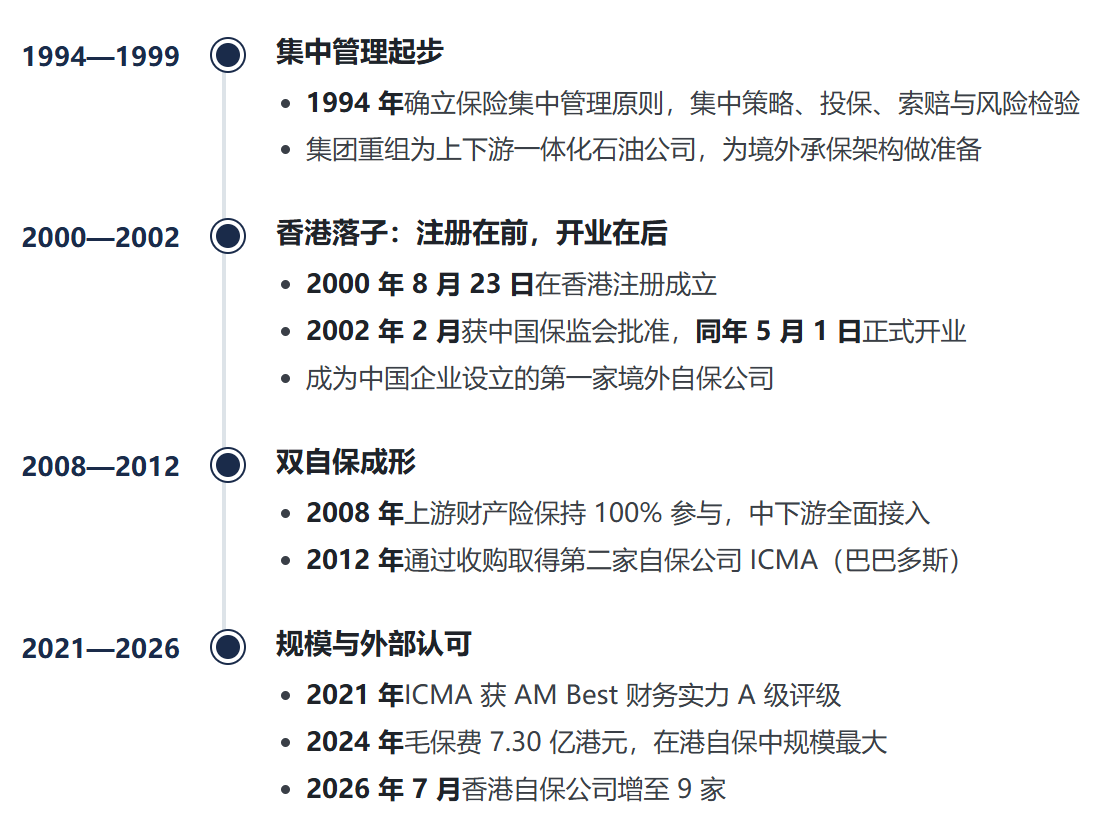
This gap encompassed three essential tasks: obtaining authorization from Hong Kong's insurance regulator and meeting capital and executive requirements; completing reinsurance contracts and ceding arrangements to give the captive the technical capacity to assume group risks; and obtaining onshore regulatory recognition for the parent company's ceding of risks to the offshore captive. Without any one of these three, the license would exist but business could not commence. This also provides a lesson for later entrants: the establishment cycle for offshore captives primarily involves "institutional alignment" rather than "company registration."
V. Ownership and Governance: Wholly Owned, Integrated into Group Centralized Insurance Management
CNOOC's captive is wholly owned by CNOOC Limited as its fully-owned property insurance subsidiary. In terms of corporate governance, it does not operate independently but is embedded within the group's overseas insurance management system of "one principle, three guarantees, five strategies": centralized insurance management as the principle; organization, systems, and talent as guarantees; and risk orientation, use of mutual insurance organizations, coordination of global markets, use of captive insurance companies, and differentiation as strategies.
At the organizational level, a three-layer division of labor has been formed: the group headquarters insurance team is responsible for global strategy, risk assessment, and reinsurance market engagement; overseas projects have dedicated local insurance management positions for on-the-ground implementation; the two captive insurance companies undertake underwriting and policy issuance functions. At the institutional level, the group has successively formulated the Overseas Insurance Management Guidelines (2020), Overseas Financial Management Measures (Insurance Section) (2021), and prepared the Overseas Insurance Operation Manual (2022), codifying which risks must be transferred and through whom into executable processes. From this perspective, the role of captives in large groups is not that of independent profit centers but execution nodes within the group's risk management system.
VI. Business Scope: Six Lines Cover the Full Offshore Oil & Gas Value Chain
Approved by the Hong Kong regulator, the company operates six classes of insurance: marine insurance, cargo transport insurance, fire and natural disaster insurance, property damage insurance, marine liability insurance, and comprehensive liability insurance. While this list of coverage classes appears standard, it corresponds to risk units unique to offshore oil and gas: drilling platforms and FPSOs, subsea pipelines and underwater wellheads, operating vessels, well control and pollution liability, and goods and third-party liability in cross-border transportation.
Participation is a key metric for understanding the substance of its business. In 2008, the company maintained 100% participation in upstream property insurance business, responsible for implementing reinsurance share placements; in downstream property insurance business, it comprehensively integrated with the insurance arrangements of each downstream enterprise. This structure of "full upstream coverage, comprehensive downstream integration" persists to this day, explaining why its premium scale is highly correlated with group capital expenditure and overseas asset scale, while having less relationship with international property and casualty market conditions.
VII. Products and Underwriting Capacity: Beyond Six Classes, Capacity Comes More from Reinsurance Than Capital
Viewed within specific projects, the company provides not standardized shelf products but a modular coverage structure: a single policy contains both the group's retained mid-to-lower layers and portions directly ceded to mutual insurance organizations and commercial markets.
Product structure is divided into upstream and downstream sets. Upstream is built on material damage insurance, layered with well control expense insurance, pollution and cleanup liability, wreck removal, and packaged as an "oil field production construction all-risk package" as project needs dictate; downstream primarily consists of enterprise property insurance, machinery damage insurance, cargo transport insurance, and comprehensive liability insurance; marine insurance and marine liability insurance serve the group's own operating vessels and floating facilities. The key to this structure is its layering — the captive covers the retention layer above the deductible, with portions exceeding retention capacity entering mutual and commercial markets.
Underwriting capacity must be viewed in three layers. The first layer is gross underwriting capacity, supported by reinsurance arrangements: the group designs limits for individual projects that can reach USD 600 million for well control and USD 700 million for environmental pollution liability. The Oil Insurance Limited (OIL) provides underwriting capacity of up to USD 400 million per occurrence and USD 1.2 billion aggregate. The second layer is net retention capacity: in 2024, net premiums were HKD 296 million, representing 40.6% of gross premiums, indicating a deliberately suppressed retention ratio — the company does not primarily rely on capital to absorb volatility. The third layer is capital: Hong Kong's minimum capital requirement for dedicated captive insurers is HKD 2 million, only one-tenth that of a regular insurer, with exemption from public disclosure, and the company's capital scale is not publicly disclosed.
This leads to a judgment: CIL's underwriting capacity is not a quota sheet available for external quotation but an internal layered arrangement within the group — the captive bears controllable mid-to-lower layers, mutual insurance organizations bear the main layer, and commercial markets fill the high-limit layer. This also explains why it can sustain an underwriting margin of around 18% over the long term: returns come from structural design rather than assuming more risk.
VIII. Dual Captive Structure: Hong Kong Issues Policies, Barbados Handles Upstream
CNOOC actually operates a dual captive structure: CNOOC Insurance Limited (CIL) in Hong Kong and ICM Assurance Ltd (ICMA) in Barbados. The former was established in 2000, the latter acquired in 2012. Both are wholly owned by the group but assigned different risk strategies and operating mechanisms to "clarify responsibility positioning, coordinate resource allocation, and coordinate business alignment."
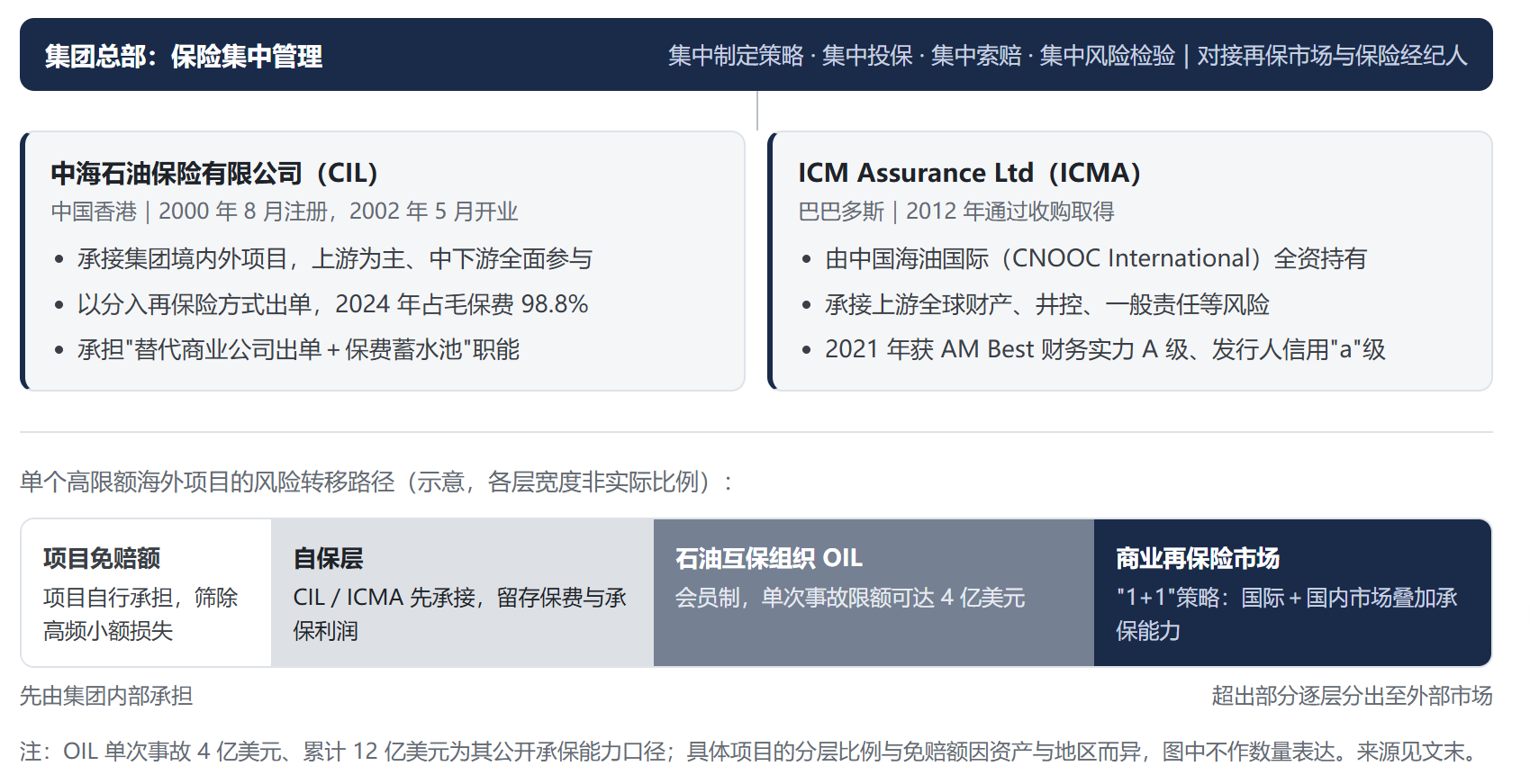
The division of labor between the two can be seen from their ownership and business scope: ICMA is wholly owned by CNOOC International, underwriting global property, well control, general liability, and other risks for parent and affiliated companies. In December 2021, AM Best upgraded its Financial Strength Rating from A- to A and its Long-Term Issuer Credit Rating to "a", citing its increasing strategic importance to the group and continued capital accumulation. CIL, by contrast, leverages Hong Kong's offshore status to perform the function of "replacing commercial companies in policy issuance": in a South American project with construction costs exceeding USD 2 billion, the group used its captive instead of a commercial insurer to issue policies, then reallocated risks through OIL membership, forming a structure where "OIL covers main risks, with captive and commercial markets supplementing." The dual captive structure is not a redundant setup but a jurisdictional layering by business geography and risk type.
IX. Operational Performance: Largest in Scale, But Profits Come from Channel Efficiency
In 2024, the company's gross premiums reached HKD 730 million, up 5.1% from HKD 695 million in 2023; the net-to-gross premium ratio remained stable at 40.6% for two consecutive years; undiscounted underwriting profit was HKD 134 million, with an underwriting margin of 18.3%. Both scale and profitability remained stable.
Metric | 2023 | 2024 |
|---|---|---|
Gross Premiums (HKD billion) | 6.95 | 7.30 |
Net Premiums (HKD billion) | 2.82 | 2.96 |
Net / Gross Premium Ratio | 40.6% | 40.6% |
Undiscounted Underwriting Profit (HKD billion) | — | 1.34 |
Underwriting Margin (Profit / Gross Premiums) | — | 18.3% |
Data Source: Hong Kong Insurance Authority Table G19 "Statistics of Individual Insurers: Underwriting Performance" (2023) and 2024 company-level provisional statistics, converted from thousands of HKD to HKD billion, ratios calculated by this report. The 2023 underwriting profit figure could not be reconciled across public sources during this verification, so it is left blank.
The nearly 60% gap between net and gross premiums represents the portion reinsured out. This means CIL functions more as a "front desk" in the structure: it accepts business ceded from group projects and issues policies, then immediately reinsures most risks back to international reinsurance markets, retaining only limited retention amounts and spreads. Therefore, the HKD 134 million undiscounted underwriting profit should not simply be interpreted as excess returns from underwriting capacity, but rather as cost savings from "replacing commercial policy issuance + centralized negotiation" reflected on the captive's books.
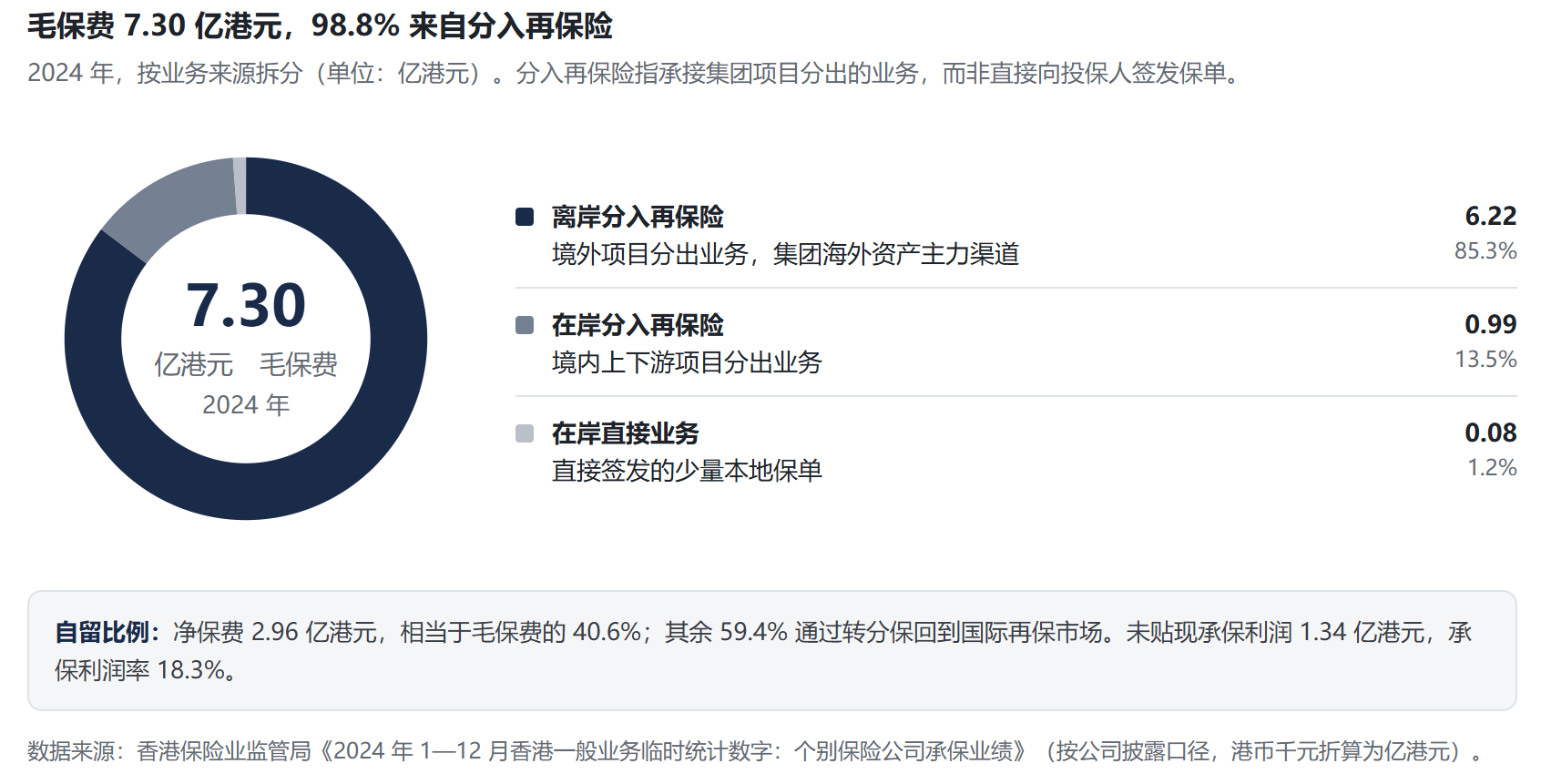
In terms of market position, CIL's 2024 gross premiums of HKD 730 million exceeded Sinopec Insurance's HKD 628 million, CGN Insurance's HKD 355 million, and Shanghai Electric Insurance's HKD 12 million, making it the largest captive insurer operating in Hong Kong. That same year, the total gross premiums of Hong Kong's captive market stood at HKD 1,723 million. In 2025, total market gross premiums rose to HKD 2,130 million, up 24% year-on-year; with SF Express and Hong Kong & Shanghai Hotels approved in July 2026, the number of Hong Kong captives increased to 9. The market is expanding, but CIL's scale changes depend more on group overseas assets and oil & gas cycles than on acquiring new clients.
X. Innovation in Captive Insurance Group Service: Treating Insurance as a Financial Tool
The company's innovation is not reflected in product forms but in integrating insurance into group financial and risk management decisions. This can be summarized in five practices.
Centralized Management "One Network": Since 1994, centralized strategy formulation, centralized placement, centralized claims handling, and centralized risk inspection. Headquarters has compiled insurance management guidelines for over 20 countries and jurisdictions, with overseas projects implementing according to local rules.
Dual Captive Coordination for Policy Issuance: CIL and ICMA are allocated by business geography and risk type, with headquarters coordinating the underwriting capacity of both captives to avoid redundant inquiries with commercial markets for the same risk.
Using Captive Instead of Commercial Companies for Policy Issuance: In South American Project C with construction costs exceeding USD 2 billion, the captive replaced commercial insurers in policy issuance, then reallocated risks through OIL membership, forming a structure where "OIL covers main risks, with captive and commercial markets supplementing."
Setting Limits with Quantitative Assessment: Coverage amounts are determined by estimated maximum loss (EML) rather than asset book value. North Sea Project B has equity assets of USD 2.3 billion, with EML measured at USD 900 million under worst-case scenarios — limits were set accordingly rather than directly insuring asset value.
"1+1" Global Market Strategy: While maintaining long-term cooperation with international energy insurance markets, introduce domestic insurance markets to participate in overseas asset underwriting, forming dual market price comparison and underwriting capacity stacking.
These practices have quantifiable financial results: the group disclosed that overseas risk and insurance management contributed RMB 380 million in financial value during the 13th Five-Year Plan period, exceeding RMB 60 million in 2021. It should be noted that this is a group-level risk management contribution figure, not equivalent to CIL's individual profits.
XI. Why Hong Kong: Tax and Regulatory Convenience as Primary Explanations
Hong Kong's institutional design for captive insurers combines "low thresholds + low taxes + limited regulation," which constitutes the primary explanation for CIL's long-term presence in Hong Kong.
Taxation: Qualifying authorized dedicated captive insurance companies enjoy a preferential profits tax rate of 8.25% on captive business profits, half of the standard corporate rate of 16.5%.
Capital and Personnel: Captive insurers are subject to simplified capital requirements, may be exempt from appointing a certified actuary, and are exempt from the requirement to maintain assets in Hong Kong to correspond to local liabilities.
Information Costs: Dedicated captive insurance companies are not subject to public disclosure requirements and are not required to publish audited financial statements and disclosure reports. This reduces operational burden and explains why external parties struggle to obtain complete data on their capital and solvency.
Policy Alignment: Among the support measures for mainland-Hong Kong cooperation announced by the State Council in June 2012 was support for mainland institutions to establish captive insurers in Hong Kong; while the China Insurance Regulatory Commission's 2002 approval resolved onshore parent companies' compliant premium ceding issues.
The variable is international tax reform. Hong Kong's preferential rate design requires continuous evaluation under the OECD's Base Erosion and Profit Shifting (BEPS) framework. If global minimum tax rules apply to the group and cover captive profits, the 8.25% rate advantage will be compressed, and the rationale for "staying in Hong Kong" will rely more on regulatory convenience, reinsurance access, and talent rather than tax differences.
XII. Comparison of Three Captive Models: CNOOC, PetroChina Dedicated, and Sinopec Insurance
Placing the three into a single table, differences do not primarily lie in scale but in "where the license is placed and what it relies on to assume risk."
Dimension | CNOOC Insurance (CIL) | PetroChina Dedicated Property Insurance | Sinopec Insurance |
|---|---|---|---|
Establishment and Domicile | Hong Kong, registered Aug 2000, commenced May 2002 | Karamay, Xinjiang, approved Dec 2013, commenced 2014 | Hong Kong, established Oct 2013 |
Shareholding and Capital | Wholly owned by CNOOC; capital not publicly disclosed | Registered capital RMB 6 billion: China Oilfield Services 49%, China Oil Capital 40%, Group 11% | Wholly owned by Sinopec; capital not publicly disclosed |
2024 Premiums | Gross premiums HKD 7.30 billion | Insurance business income RMB 15.26 billion | Gross premiums HKD 6.28 billion |
2024 Profitability | Undiscounted underwriting profit HKD 1.34 billion | Net profit RMB 2.36 billion | Undiscounted underwriting profit HKD 1.38 billion |
Retention and Reinsurance | Net / Gross premium ratio 40.6% | Direct onshore underwriting, ceding metrics not comparable | Net / Gross premium ratio 34.4% |
Capital Adequacy | Not disclosed; regulatory minimum capital HKD 2 million | Comprehensive solvency ratio 398.1%, core 385.8% | Not disclosed; S&P A+ 2016-2020 |
Functional Positioning | Policy issuance and reinsurance channel for group onshore and offshore projects | Onshore licensed, serving group full industry chain | Coordinated underwriting for offshore assets and business |
Data Source: Hong Kong Insurance Authority 2024 company-level provisional statistics; PetroChina Dedicated Property Insurance 2024 Annual Information Disclosure Report; Sinopec 2021 Hong Kong Sustainable Development Report. No FX conversion applied between HKD and RMB.
PetroChina Dedicated is largest in scale, while the two Hong Kong captives are more stable. PetroChina Dedicated's 2024 insurance business income was RMB 15.26 billion, while CIL's gross premiums were HKD 7.30 billion. The two differ in currency and measurement (the former is direct onshore underwriting income, the latter includes substantial inward reinsurance), so they should not be directly subtracted. But PetroChina Dedicated's profit volatility is clear: premiums from 2023-2025 were RMB 11.47, 15.26, and 18.08 billion, with net profits of RMB 4.59, 2.36, and 0.61 billion respectively — premiums continued growing in 2025 while profits fell sharply. Over the same period, CIL's 2024 undiscounted underwriting profit was HKD 1.34 billion, with a net-to-gross ratio of 40.6% in both 2023 and 2024 — underwriting results did not swing to the same degree. The difference stems from the model: onshore captives underwrite directly within the group and bear full underwriting results; offshore captives are primarily inward reinsurance with low retention ratios, with volatility isolated by reinsurance contracts.
The relationship between capital and underwriting capacity is fundamentally different. PetroChina Dedicated supports its business with RMB 6 billion of registered capital, with comprehensive solvency of 398.1% and core 385.8% at end-2024. The two Hong Kong captives follow a "light capital + heavy reinsurance" path, with regulatory minimum capital of only HKD 2 million and no public disclosure of capital. Their underwriting capacity is primarily reflected in reinsurance contracts rather than own capital. Therefore, premium scale alone cannot be used to compare the underwriting strength of the three.
Sinopec Insurance is the closest control group for CIL. Both were established around 2013, both do offshore policy issuance in Hong Kong. In 2024, gross premiums were HKD 7.30 vs 6.28 billion, net-to-gross ratios 40.6% vs 34.4%, underwriting margins 18.3% vs 22.0%. Sinopec cedes more and has a higher underwriting margin, reflecting greater reliance on reinsurance channels and centralized pricing authority at headquarters. CIL, with a higher proportion of upstream high-limit business, has a slightly lower reinsurance cession ratio and relatively higher retention. As a supplementary reference, CGN Insurance's 2024 gross premiums were HKD 3.55 billion with a net-to-gross ratio of 72.9%, indicating that captives primarily serving onshore nuclear power business have significantly higher retention ratios — each of the three structures has its tradeoffs.
The four Hong Kong captives' 2024 gross premiums totaled approximately HKD 17.2 billion, essentially matching the Hong Kong captive market total of HKD 17.23 billion, meaning the market was almost entirely comprised of energy and equipment manufacturing enterprises that year. Only after SAIC, CNNC, Hong Kong & Shanghai Hotels, and SF Express entered the market after 2025 did the structure begin to diversify.
XIII. Structural Differences Are Fundamental: The Asset and Business Layout of the Three Giants Determines Captive Approach
While the three captive insurers all assume group insurance, their differences in license form, premium composition, and underwriting approach originate not from insurance itself but from the three groups' industry chain position, overseas asset ratio, and single-point risk concentration. First look at the structure, then at how it transmits to insurance.
Dimension (2024) | CNOOC | PetroChina | Sinopec |
|---|---|---|---|
Business Structure | Pure upstream (offshore oil & gas E&P) + natural gas and new energy | Integrated full industry chain: upstream + refining + sales | Primarily refining + sales + chemicals, upstream as supplement |
Crude Oil Production Base Structure | Primarily domestic offshore (Bohai, South China Sea), high proportion of overseas offshore fields (Guyana, Brazil, North Sea, etc.) | Primarily domestic onshore (Daqing, Changqing, Tarim, etc.), overseas primarily onshore fields and cross-border long-distance pipelines | Primarily purchased and imported crude oil, low self-produced proportion (Shengli, Zhongyuan and other mature onshore fields) |
2024 Oil & Gas Equivalent Production | 726.8 million boe (+7.2%) | 1,797.4 million boe (+2.2%) | 515.35 million boe (+2.2%) |
2024 Net Profit Attributable to Parent | RMB 137.9 billion (+11.4%) | RMB 164.68 billion (+2.0%) | RMB 50.31 billion (-16.8%) |
Refining and Sales Scale | No large refining and sales network | Processed 13.78 billion barrels crude, produced 121 million tons refined fuel | Produced 153 million tons refined fuel, total sales 239 million tons |
Overseas Assets and Production Ratio | Over 20 countries, 40+ projects overseas; overseas assets 30%+ of group, overseas production 40%+ | Primarily domestic; overseas oil & gas equivalent ratio approximately 11% | Primarily domestic refining and sales, very low overseas ratio |
Captive License Form | Hong Kong CIL + Barbados ICMA (offshore dual captive) | Onshore PetroChina Dedicated Property Insurance (licensed) | Hong Kong SIL + onshore captive fund (early stage) |
Data Source: 2024 annual reports of the three companies and SASAC disclosures; CNOOC's overseas ratio cited from China Petroleum Enterprises magazine. Oil & gas production figures are based on each listed entity's disclosures.
Industry chain position determines insurance class combination. CNOOC is a pure upstream company, with risks concentrated in high-value single points like offshore oil fields, FPSOs, and drilling operations. Therefore, CIL's core coverage classes are material damage, well control, and pollution liability — high gross premiums, large single-point limits. Sinopec, focused on refining, sales, and chemicals, has assets dispersed across facilities, pipelines, and gas station networks. Hong Kong SIL's coverage focuses on standard property and liability, plus cargo, with small individual risk amounts. PetroChina spans the entire chain, so its onshore dedicated property insurer covers almost everything from oil fields and refining facilities to sales and logistics — explaining its largest premium volume and most diversified risk portfolio.
Overseas asset ratio determines whether offshore captive insurance is needed. CNOOC's overseas assets exceed 30% of group total, with overseas production over 40%. High-limit overseas projects must connect to international reinsurance and mutual insurance systems, explaining why it was the earliest to establish CIL in Hong Kong and subsequently acquire ICMA. Sinopec also established Hong Kong SIL, but with its asset center in domestic refining and sales, overseas coordination volume is relatively small — SIL's gross premiums (HKD 6.28 billion) are lower than CIL's (HKD 7.30 billion), primarily consisting of offshore cessions. PetroChina, focused on domestic business, follows the onshore licensed path, using PetroChina Dedicated Property Insurance to underwrite directly without relying on offshore licenses.
Crude oil production structure determines risk geographic attributes, which in turn determine retention and ceding. CNOOC's self-produced oil & gas is highly concentrated offshore and overseas, with extremely high single-asset values and strong local insurance regulatory barriers. Captives can only function through offshore policy issuance + international reinsurance, forcing low retention ratios (net-to-gross 40.6%). PetroChina's self-produced resources are primarily domestic onshore, with overseas oil & gas equivalent ratio of only about 11%. Its risk pool comprises millions of oil wells, tens of thousands of kilometers of pipelines, and refining networks — naturally diversified — giving it the conditions for high retention with RMB 6 billion capital and direct underwriting. Sinopec's self-produced crude ratio is low, primarily purchasing and processing, so crude risk manifests more as cargo, inventory, and refining facility risk rather than production operation risk. Its Hong Kong captive only coordinates scattered offshore business, with the lowest retention willingness (net-to-gross 34.4%, leaning toward pure channel).
Single-point risk concentration determines reinsurance cession ratio and underwriting margin. CNOOC has many high-value single-point risks with high limits and limited retention capacity — net-to-gross 40.6%, underwriting margin 18.3%. Sinopec's offshore business consists primarily of diversified standard property and liability, with lower cession ratios (net-to-gross 34.4%) and higher underwriting margins (22.0%). PetroChina Dedicated Property Insurance underwrites directly onshore without cession channels, using RMB 6 billion capital to absorb full underwriting results, hence the need to maintain high solvency ratios.
Group profitability cycles also transmit to captive insurers. In 2024, CNOOC's net profit attributable to parent was RMB 137.9 billion (+11.4%), PetroChina RMB 164.68 billion (+2.0%), and Sinopec RMB 50.31 billion (-16.8%). The structural difference of upstream prosperity versus downstream pressure correlates with PetroChina Dedicated Property Insurance's premium growth from 2023-2025 while net profit fell from RMB 4.59 billion to 0.61 billion — captive insurers are not risk shelters but mirrors of group main business operating results and underwriting cycles in the insurance segment.
Business structure determines captive approach: Industry chain position, overseas ratio, and single-point risk concentration jointly determine license form and underwriting approach.
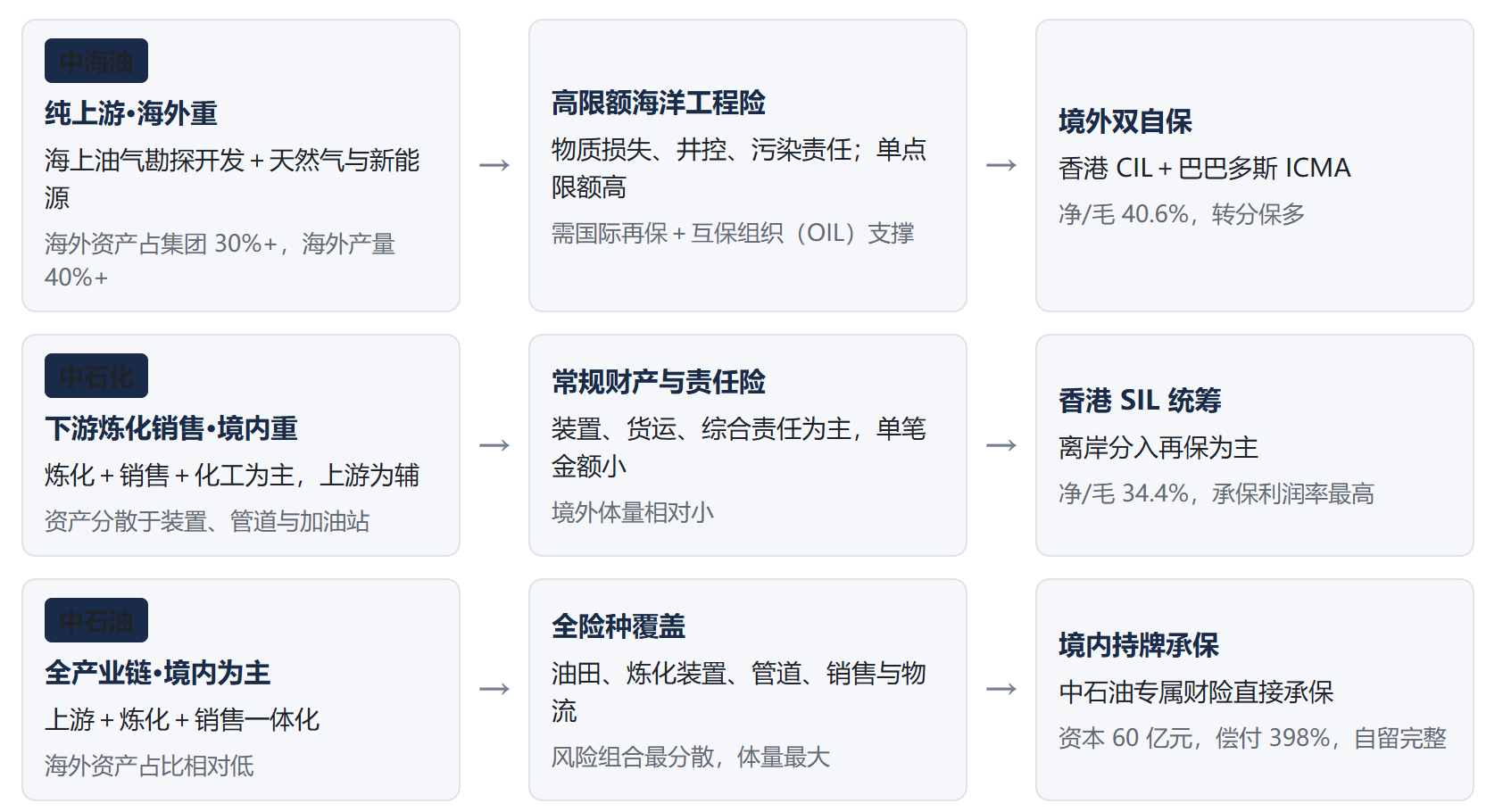
The conclusion from the above is: the "Three Giants" differ not in whether they have captive insurance, but in which industry chain segment they place their license. CNOOC, due to pure upstream and high overseas ratio, made its captive an offshore channel connecting to international reinsurance. Sinopec, focused on downstream, made its captive a coordination tool for onshore risks. PetroChina, due to full industry chain and domestic focus, made its captive an onshore license for direct underwriting. Understanding this prerequisite provides a unified explanatory framework for the data differences among the three captive insurers described above.
XIV. International Benchmark: BP's Dual Captive System and Operational Performance
Placing the three Chinese companies into a global coordinate, the most direct reference is British Petroleum (BP), which similarly uses insurance as a group tool. BP's dual captive architecture is almost identical to CNOOC's, but with diametrically opposite operating philosophies — forming a perfect point of comparison.
Architecture: Both "dual captives" — one issues, one assumes. BP has two captive insurers: Jupiter Insurance in Guernsey handles core insurance and reinsurance for the group's international oil & gas assets, while Saturn Insurance in Vermont underwrites specific U.S. domestic risks (terrorism, workers' compensation, environmental liability, etc.). This mirrors CNOOC's "Hong Kong CIL issues + Barbados ICMA handles upstream" structure — both issue policies from a primary operating regulatory area, then concentrate assumption and reinsurance in offshore financial zones.
Operating Model:BP is more aggressive, using captives as profit centers and tax tools. BP has long significantly reduced external commercial insurance, retaining most risk within captives: Jupiter has approximately USD 6 billion in capital, purchases no external reinsurance, and has underwriting limits of USD 700 million per occurrence for material damage and business interruption. According to AM Best and BP financial estimates, Jupiter's profits once accounted for approximately 14% of BP's global annual profits; it has no employees, is managed by Guernsey brokers, and has long been viewed by researchers as using offshore structures for profit and tax arrangements. By contrast, CNOOC's CIL deliberately suppresses retention ratios at 40.6%, relying on OIL mutual and commercial reinsurance layering, and does not treat its captive as a profit center.
Performance Measurability: One has ratings, one is fully internalized. Jupiter participates in AM Best interactive ratings, with long-term Financial Strength Rating of A (Excellent) and Issuer Credit Rating "a", confirmed in September 2026, reflecting a very strong balance sheet. CNOOC's CIL, due to Hong Kong's exemption from public disclosure and no rating application, keeps capital scale and solvency unobservable externally — performance can only be compared based on available disclosures and industry estimates, not using uniform financial statement standards.
Dimension | British Petroleum (BP) | CNOOC (CIL/ICMA) |
|---|---|---|
Captive System | Jupiter (Guernsey · Core reinsurance) + Saturn (Vermont · U.S. domestic, dissolved Aug 2026) | CIL (Hong Kong · Policy issuance) + ICMA (Barbados · Upstream assumption) |
Operating Orientation | Reduces external commercial insurance, concentrates risk retention, high captive profit ratio | Suppresses retention ratio (40.6%), relies on OIL mutual + commercial reinsurance layering |
Capital and Ratings | Jupiter capital approximately USD 6 billion, no external reinsurance, AM Best A/a | Not disclosed, no rating, Hong Kong exempts public disclosure |
Per-Occurrence Underwriting Limit | Material damage / business interruption USD 700 million | Project-level well control up to USD 600 million, pollution USD 700 million (EML measurement) |
Catastrophe Buffer | Own capital, no external reinsurance | OIL mutual + commercial reinsurance layer, low retention ratio |
Profit Positioning | Once accounted for approximately 14% of BP global annual profits, now reduced | Profits not separately disclosed, channel-oriented, replacing commercial issuance + centralized negotiation cost savings |